
Defining KYC Zero in Regulated Markets
In the current regulatory landscape, "KYC Zero" is frequently misunderstood as a synonym for anonymous, unregulated trading. This conflation obscures a critical technical distinction. True KYC Zero does not eliminate compliance; it decouples the proof of eligibility from the disclosure of identity. It represents a structural shift from data hoarding to data minimization, allowing financial institutions to verify regulatory criteria without storing sensitive personally identifiable information (PII).
Traditional KYC processes require users to submit government-issued identification and proof of address. These documents are stored in centralized databases, creating high-value targets for data breaches and regulatory liability. In contrast, Zero-Knowledge Proof KYC (ZK-KYC) utilizes cryptographic protocols to generate a mathematical proof that a user meets specific criteria—such as being over 18 or residing in a permitted jurisdiction—without revealing the underlying personal data. The verifier accepts the proof as valid without ever seeing the source document.
This approach aligns with the "privacy by design" principles increasingly mandated by regulators. By using ZKPs, platforms can satisfy Anti-Money Laundering (AML) and Know Your Customer obligations while significantly reducing the attack surface for identity theft. The goal is not to evade oversight but to modernize verification infrastructure, ensuring that compliance remains robust without compromising user privacy.
The transition to ZK-KYC is driven by both regulatory pressure and consumer demand for privacy. As data protection laws like the GDPR tighten, the liability of holding unnecessary personal data becomes untenable for many institutions. ZK-KYC offers a path forward where regulatory compliance is enforced through cryptography rather than custody of personal records, marking a significant evolution in financial infrastructure.
How zero-knowledge proofs enable privacy
Zero-knowledge proofs (ZKPs) allow a user to prove a specific predicate about their identity without disclosing the underlying personal information. In a KYC context, this means a regulated entity can verify that a customer meets legal requirements—such as being over 18 or residing in a specific jurisdiction—without ever accessing their name, address, or date of birth. This mechanism fundamentally decouples identity verification from data exposure.
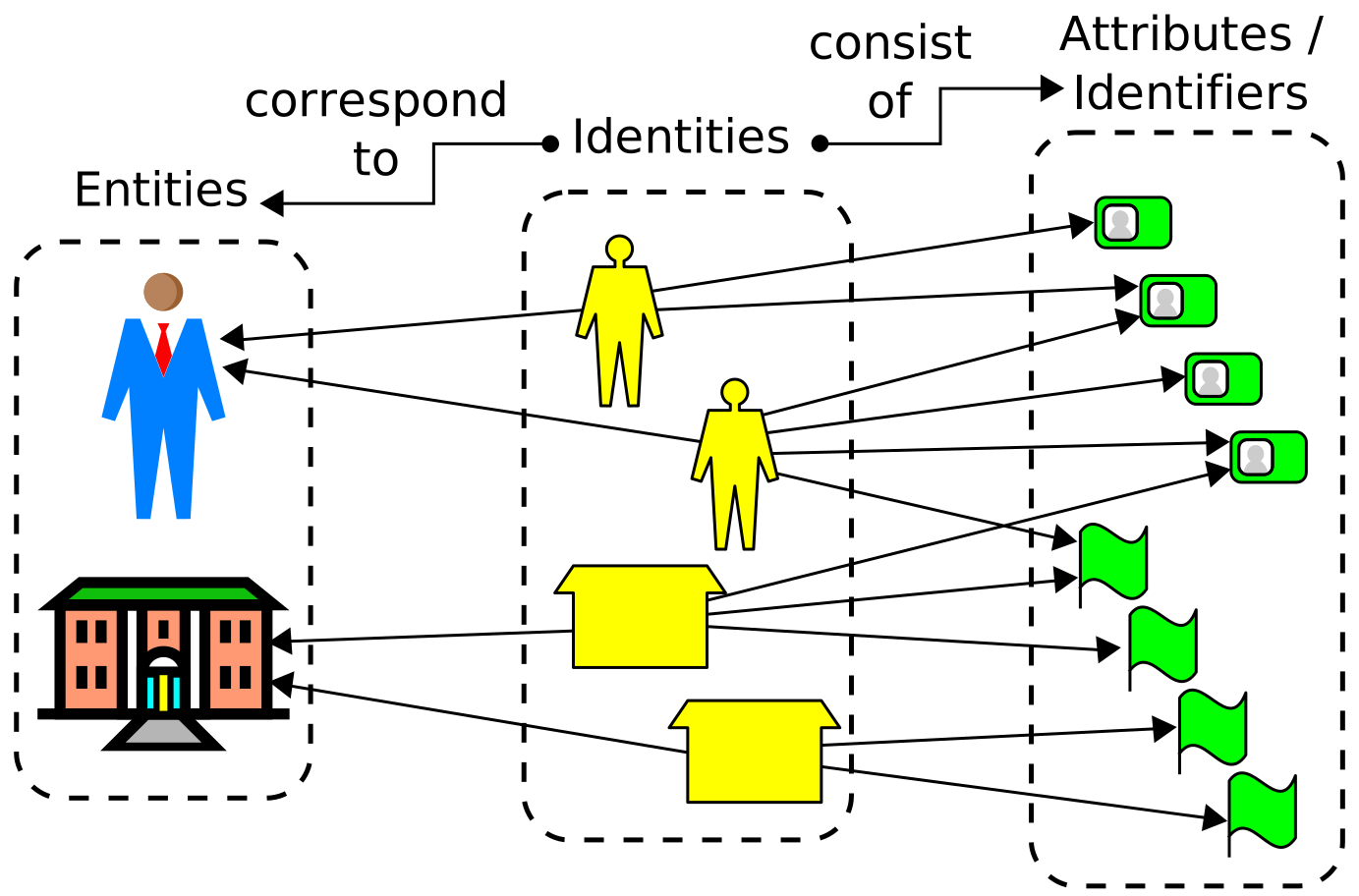
The technical process involves generating a cryptographic proof that attests to the truth of a statement. For example, a user can generate a proof confirming their age is greater than 18 based on a trusted credential issued by a government authority. The verifier checks the proof against public parameters and accepts it as valid if the predicate holds true. The verifier learns nothing beyond the validity of the statement itself.
This approach addresses a critical vulnerability in traditional KYC systems: the creation of centralized data honeypots. By eliminating the need for service providers to store sensitive personal data, ZKPs reduce the attack surface for data breaches and mitigate the risk of identity theft. The verification remains compliant with regulatory standards while preserving user privacy.
The Shift to Self-Sovereign Identity
Institutional compliance is undergoing a structural transition from centralized data hoarding to decentralized verification. Regulators and financial institutions are increasingly recognizing that traditional Know Your Customer (KYC) models, which rely on aggregating sensitive personal data in single-point databases, present unacceptable liability profiles. The market is now pivoting toward Self-Sovereign Identity (SSI) frameworks, where individuals control their credentials and institutions verify them without storing the underlying data.
This shift is driven by the inadequacy of legacy systems in the face of modern regulatory requirements and cyber threats. Centralized databases have become primary targets for breaches, exposing millions of records and resulting in significant regulatory penalties. In contrast, decentralized identity standards like those emerging from eIDAS 2.0 in the European Union allow for verifiable credentials that are cryptographically secured. This architecture ensures that compliance is achieved through zero-knowledge proofs, validating attributes such as age or residency without revealing the actual identity documents.
The adoption of these standards is not merely a technological upgrade but a legal necessity. Financial institutions are moving away from storing raw identity data, which creates a permanent attack surface, toward systems that validate proofs on-chain or via secure off-chain channels. This approach aligns with the principle of data minimization, a core tenet of modern privacy laws. By verifying the validity of a credential without accessing the raw data, institutions reduce their exposure to liability while maintaining strict AML and CFT compliance.
| Feature | Traditional KYC | KYC Zero (ZKP/SSI) |
|---|---|---|
| Data Storage | Centralized database | User-held wallet |
| Verification | Manual or automated review of raw docs | Cryptographic proof validation |
| Data Exposure | High (full PII stored) | Minimal (only proof revealed) |
| Breach Risk | High (single point of failure) | Low (no central repository) |
| Compliance | Static record keeping | Dynamic, real-time verification |
Regulatory hurdles and compliance risks
The transition to zero-knowledge identity verification is not merely a technical upgrade; it is a structural challenge to existing financial compliance frameworks. Regulators are currently grappling with the Anti-Money Laundering Act (AMLA) mandates, which require institutions to verify the identity of their customers. Zero-knowledge proofs (ZKPs) disrupt this by allowing a platform to prove a user is who they claim to be without revealing the underlying identity data. This creates a fundamental tension: how can a regulated entity satisfy legal due diligence when the proof itself obscures the very information the law demands?
To navigate this, regulators are applying a 'per-decision defensibility' test. This standard requires that every compliance decision—such as approving a transaction or onboarding a user—must be legally defensible in the event of an audit or enforcement action. Traditional KYC provides a static record of identity that can be reviewed post-hoc. ZKPs, by contrast, offer dynamic, cryptographic proofs of compliance status. The challenge lies in proving that the ZKP was generated correctly and corresponds to a verified identity held by a trusted third party, without exposing that identity to the verifier.
Official sources, including academic research on zkKYC concepts, suggest that this model can preserve financial privacy while meeting regulatory requirements. However, the implementation requires rigorous oversight of the identity issuers—the entities that perform the initial identity check. If the issuer is compromised or acts maliciously, the entire zero-knowledge system fails. Therefore, the regulatory focus must shift from verifying customer data to auditing the integrity of the identity issuance infrastructure. This shift demands new standards for cryptographic accountability and real-time compliance monitoring.
| Feature | Traditional KYC | Zero-Knowledge KYC |
|---|---|---|
| Data Storage | Centralized database | Distributed cryptographic proofs |
| Privacy | Minimal; full identity shared | High; only attributes proven |
| Auditability | Post-hoc record review | Real-time proof verification |
No comments yet. Be the first to share your thoughts!