
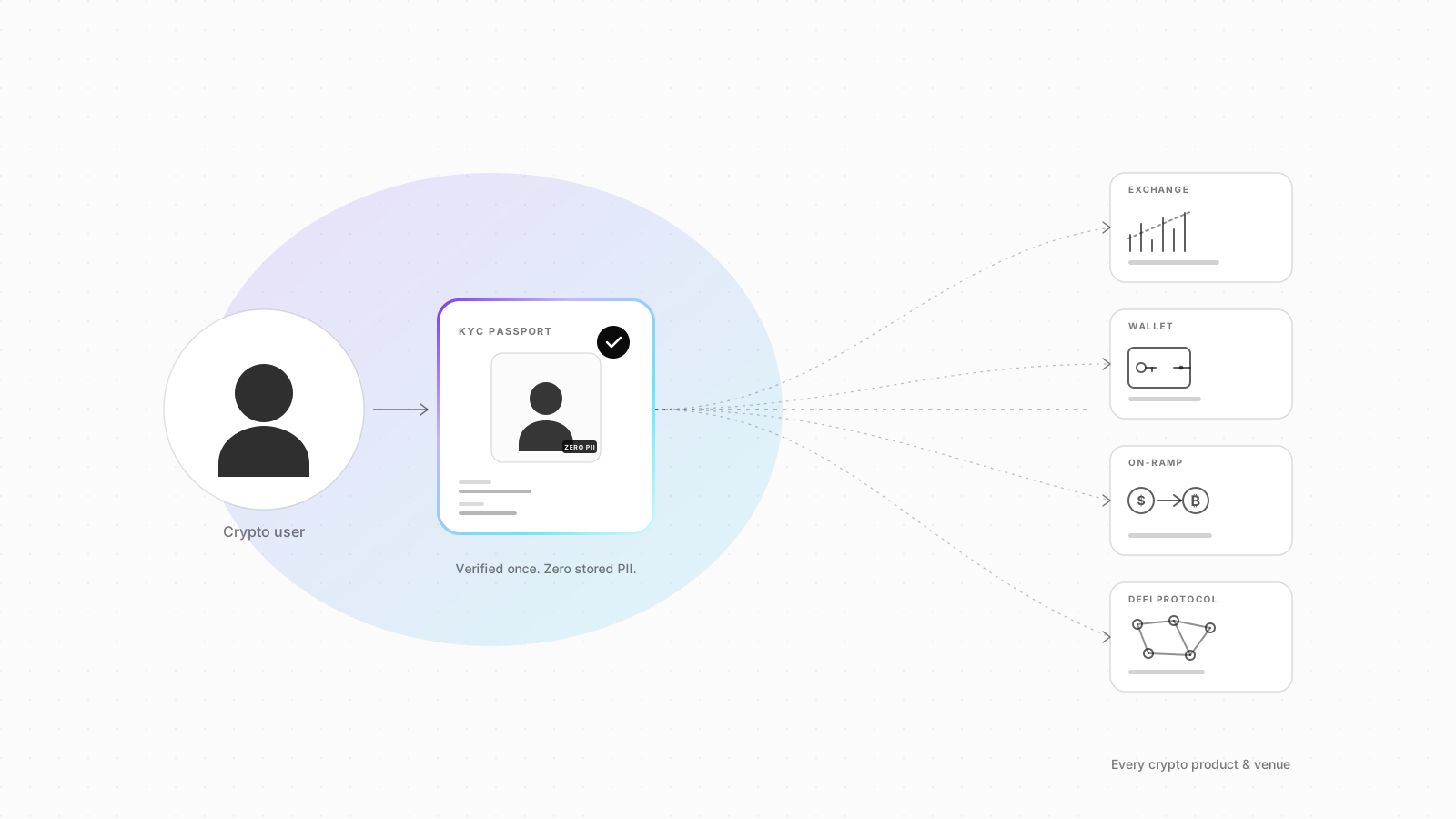
Defining KYC Zero in Modern Compliance
In 2026, the fintech landscape is shifting away from the binary choice of "full KYC" or "no KYC." This false dichotomy ignores the emerging standard of KYC zero, a model that prioritizes regulatory compliance while eliminating user friction. Understanding this distinction is critical for operators navigating the current regulatory environment, where passive identity verification has become the operational norm rather than an optional feature.
The term "KYC zero" is often misinterpreted as a lack of verification entirely. This is incorrect. True KYC zero does not mean ignoring anti-money laundering (AML) obligations. Instead, it means the verification process occurs invisibly in the background. The user completes transactions without the traditional, high-friction steps of uploading government IDs, waiting for manual approval, or filling out lengthy forms. As noted in recent industry analyses, the modern reality is a "lighter checkout" that reduces waiting times and intrusive data collection without sacrificing security.
KYC zero does not mean no verification. It means verification happens in the background without user friction.
This approach aligns with the broader 2026 fintech trends toward privacy-preserving technologies. By leveraging biometric checks, device fingerprinting, and behavioral analysis, platforms can verify identity continuously and non-intrusively. This allows regulated entities to maintain robust compliance records while offering users a seamless experience that feels like having no KYC at all, despite the rigorous checks running behind the scenes.
How passive identity verification works
Passive identity verification shifts the burden of proof from the user to the system. Instead of requiring customers to manually upload passports or selfies, the platform collects digital footprints—such as device fingerprints, behavioral biometrics, and transaction patterns—to verify identity in the background. This approach aligns with 2026 fintech trends by reducing friction while maintaining rigorous compliance standards.
At the core of this mechanism is the Zero-Knowledge Proof (ZKP). A ZKP allows a verifier to confirm that a statement about a customer is true without revealing the underlying data. For example, a bank can verify a user is over 18 and a resident of the European Union without ever seeing their birthdate or address. This cryptographic method ensures that raw personally identifiable information (PII) never leaves the user’s device or is stored centrally, significantly reducing the risk of data breaches.
The system passively gathers signals from the user’s device and interaction patterns. These signals include typing cadence, mouse movements, and device metadata, creating a unique behavioral profile without asking for explicit documents.
Using zero-knowledge cryptography, the platform generates a mathematical proof that validates the user’s eligibility criteria. This proof confirms compliance attributes—such as age or jurisdiction—without exposing the actual PII.
The verifier receives only the proof, not the data. The system validates the cryptographic signature against regulatory requirements. If the proof holds, the user is verified; if not, the request is denied without any sensitive data being exposed.
This architecture creates a secure, privacy-preserving loop. By decoupling verification from data storage, financial institutions can meet strict regulatory obligations while offering a seamless experience that feels invisible to the customer.
2026 Regulatory Landscape for Frictionless Onboarding
The regulatory environment in 2026 has moved beyond simple compliance checklists to mandate a fundamental shift in how identity data is handled. Regulations like eIDAS 2 and the Anti-Money Laundering Act (AMLA) are no longer obstacles to frictionless onboarding; they are the architectural blueprint for it. The era of data hoarding is ending. Regulators now prioritize verifiable credentials and zero-knowledge proofs, allowing financial institutions to verify a user’s eligibility without storing sensitive personal information.
This shift redefines KYC zero from a user-experience enhancement to a regulatory requirement. Under eIDAS 2, digital wallets and identity schemes are standardized across the EU, reducing the fragmentation that previously forced users to re-verify across borders. Similarly, AMLA’s updated risk-based approach encourages institutions to use passive identity verification methods that minimize data collection while maintaining audit trails. The goal is no longer to collect everything, but to verify what is necessary with cryptographic certainty.
For fintech platforms, this means integrating passive identity verification at the protocol level. Instead of asking users to upload passports and wait for manual review, systems now verify digital credentials in real-time. This reduces onboarding time from days to seconds while ensuring compliance with the strictest data protection standards. The result is a cleaner, more secure user journey that aligns with both regulatory expectations and consumer privacy demands.
Passive KYC provider models and trade-offs
Evaluating passive identity verification requires distinguishing between the underlying verification models and the specific vendors implementing them. In 2026, the market has bifurcated into two primary approaches: cryptographic proofs and behavioral biometrics. Understanding these distinctions is essential for selecting a KYC zero strategy that balances regulatory compliance with user friction reduction.
ZK-proofs and cryptographic verification
Zero-knowledge proofs (ZKPs) allow a user to prove they meet certain criteria without revealing the underlying data. This model is ideal for high-privacy jurisdictions. It shifts the verification burden from the institution to the user’s digital wallet, reducing data liability for fintechs. However, ZK adoption is currently limited by the maturity of supporting infrastructure and user education requirements.
AI-driven behavioral analysis
Behavioral analysis uses AI to assess risk based on interaction patterns, such as typing speed or device handling. This method operates in the background, often invisible to the user. It excels at continuous monitoring rather than one-time onboarding. While it reduces initial friction, it requires significant historical data to train models accurately, posing a barrier for newer entrants.
Comparative analysis of verification models
The table below contrasts the key operational differences between these two dominant passive KYC approaches. This comparison focuses on verification speed, privacy preservation, and current regulatory acceptance to aid in provider selection.
Implementing KYC Zero Without Compliance Risk
Integrating passive identity verification into existing workflows requires shifting from raw data collection to verifiable credentials. This approach allows platforms to validate user status—such as age or residency—without storing sensitive personally identifiable information (PII). By leveraging zero-knowledge proofs, you ensure that only the necessary assertions are shared with your compliance engine, significantly reducing the attack surface for data breaches.
Audit trails must remain immutable to satisfy regulatory scrutiny. When a user passes a passive check, the system should record a cryptographic proof of verification rather than a copy of their documents. This method aligns with the principle of compliance without building a data honeypot, ensuring that your platform remains accountable without becoming a target for malicious actors.
Prioritize verifiable credentials over raw data collection to future-proof your compliance stack.
Finally, validation must rely on official sources. Integrating with trusted identity providers ensures that the data underpinning your KYC zero framework is accurate and up-to-date. This reliance on primary sources maintains the integrity of your verification process while minimizing the operational friction that typically hinders user onboarding.
Frequently asked questions about KYC zero
What is KYC zero?
KYC zero, often referred to as zero-KYC or no-KYC, is a simplified verification model that allows users to transact without undergoing full Know Your Customer (KYC) checks. In the 2026 fintech landscape, this approach prioritizes passive identity verification, reducing friction by minimizing intrusive steps and waiting times at regulated fiat gateways.
How does passive identity verification work?
Passive identity verification automates the compliance process by analyzing user behavior and transaction patterns in the background. Instead of requiring manual document uploads, the system uses data signals to verify identity continuously. This method aligns with emerging 2026 fintech trends that favor seamless, non-disruptive user experiences while maintaining regulatory adherence.
Is KYC zero the same as traditional KYC?
No. Traditional KYC requires upfront, explicit submission of identity documents before any transaction occurs. KYC zero replaces this with a lighter checkout experience, often deferring or eliminating initial checks. While traditional KYC is static, KYC zero is dynamic, relying on ongoing risk assessment rather than a one-time verification event.
No comments yet. Be the first to share your thoughts!