
Defining KYC Zero in 2026
The term "KYC Zero" is frequently misunderstood as a synonym for "no-KYC" services that bypass identity verification entirely. This distinction is critical for compliance professionals operating in 2026. Traditional no-KYC models allow anonymous transactions, which directly violate Anti-Money Laundering (AML) and Know Your Customer (KYC) mandates enforced by the Financial Action Task Force (FATF) and regional regulators like the EU’s MiCA framework. In contrast, KYC Zero refers to a privacy-preserving compliance architecture that satisfies regulatory requirements without storing or exposing personal identifiable information (PII).
KYC Zero leverages Zero-Knowledge Proofs (ZKPs) to verify specific predicates about a user’s identity—such as age, residency, or sanction list status—without revealing the underlying data. For example, a user can cryptographically prove they are over 18 and reside in the European Union to a verifier, while the verifier never sees their birth date or address. This approach aligns with the data minimization principles embedded in the General Data Protection Regulation (GDPR) and emerging US state-level privacy laws.
This methodology shifts the compliance burden from data hoarding to cryptographic verification. Regulators require proof of identity and jurisdiction; they do not require custodians to retain copies of passports or utility bills. By adopting KYC Zero, financial institutions and decentralized protocols can demonstrate adherence to EU and US regulatory frameworks while eliminating the security risks associated with centralized databases of sensitive user data.
Zero-Knowledge Proofs in Identity Verification
Zero-Knowledge Proof KYC (ZK-KYC) represents a structural shift in how regulated entities satisfy compliance obligations without maintaining a data honeypot. Unlike traditional Know Your Customer protocols, which require the custodial storage of personally identifiable information (PII), ZK-KYC applies cryptographic rigor to the compliance layer. This mechanism allows a user to prove they meet specific regulatory criteria—such as age or jurisdictional residency—to a verifier without revealing the underlying personal data.
The technical architecture of KYC Zero relies on a three-party interaction between the user, the issuer (a trusted identity provider), and the verifier (the regulated business). The issuer validates the user’s identity against official records and issues a cryptographically signed credential. The user then generates a zero-knowledge proof from this credential, demonstrating that the embedded attributes satisfy the verifier’s policy requirements. The verifier checks the proof’s validity without ever accessing the raw identity data.
This approach aligns with the principle articulated in the zkKYC solution concept, which removes the need for the customer to share any personal information with a regulated business for the purpose of KYC. By decoupling verification from data retention, ZK-KYC mitigates the risk of large-scale identity breaches while maintaining adherence to anti-money laundering (AML) and counter-terrorism financing (CTF) frameworks.
The implementation of KYC Zero ensures that compliance remains robust under both EU and US regulatory standards. Under the EU’s General Data Protection Regulation (GDPR), the principle of data minimization is strictly enforced; ZK-KYC satisfies this by ensuring that only the necessary proof of eligibility is transmitted, rather than the full identity dossier. Similarly, US regulatory bodies, including the Financial Crimes Enforcement Network (FinCEN), focus on the outcome of the verification rather than the method of data storage, provided the audit trail remains immutable and verifiable.
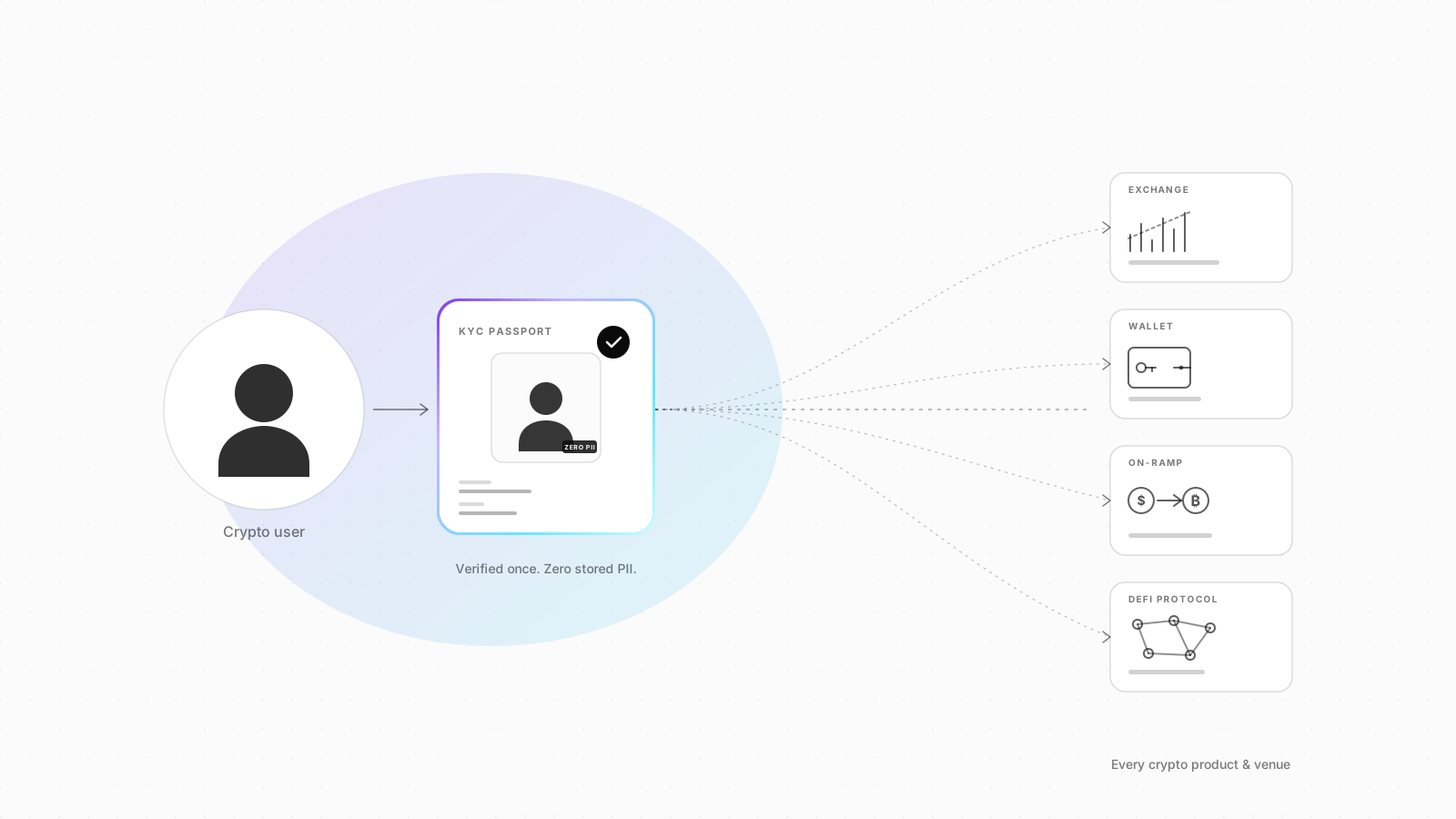
The cryptographic flow of a ZK-proof verification step in a KYC transaction is complex, but its regulatory impact is straightforward. It transforms identity verification from a data collection exercise into a proof-based interaction. This shift is critical for high-stakes compliance environments where the liability of data exposure is as significant as the risk of regulatory non-compliance.
EU and US Regulatory Alignment
KYC Zero represents a structural shift in how financial institutions satisfy compliance mandates without violating data privacy principles. By utilizing Zero-Knowledge Proofs (ZK-KYC), platforms can verify regulatory criteria—such as age or jurisdiction—without exposing underlying personal identifiable information (PII). This approach aligns directly with the European Union’s stringent data minimization requirements under the General Data Protection Regulation (GDPR) and the eIDAS 2 framework, which prioritize the protection of user identity data.
Under traditional KYC models, institutions collect and store extensive personal records, creating significant liability and security risks. In contrast, KYC Zero allows a verifier to confirm a statement about a customer is true, such as being over 18 and an EU resident, without ever accessing the raw data. This distinction is critical for high-stakes compliance, where the exposure of sensitive data can lead to severe regulatory penalties and reputational damage.
The following comparison illustrates how KYC Zero differs from traditional methods across key regulatory dimensions in the EU and US markets.
| Feature | Traditional KYC | KYC Zero (ZK-KYC) | Regulatory Alignment |
|---|---|---|---|
| Data Storage | Full PII stored by verifier | Zero PII stored; only proofs retained | Aligns with GDPR Article 5 (Data Minimization) |
| Verification Scope | Broad data collection (passport, selfie, address) | Specific attribute verification (age, jurisdiction) | Meets eIDAS 2 qualified trust service requirements |
| Data Breach Risk | High; centralized honeypot for attackers | Minimal; no sensitive data to exfiltrate | Reduces liability under US AML and EU DPA |
| User Consent | Implicit via broad terms of service | Explicit, granular, and revocable | Satisfies strict consent requirements in both jurisdictions |
This technical architecture ensures that KYC Zero satisfies the stringent data minimization requirements of the EU while maintaining the robustness required by US Anti-Money Laundering (AML) frameworks. By decoupling verification from data retention, institutions can achieve compliance without compromising the fundamental right to privacy.
Biometric AI and Frictionless Onboarding
Biometric AI is reshaping the infrastructure of KYC Zero by shifting verification from document-heavy checks to continuous, passive identity confirmation. In this framework, the user’s biometric signature—facial geometry, voice patterns, or behavioral keystrokes—serves as the primary credential, eliminating the need for repetitive data submission. This approach aligns with the core promise of KYC Zero: maintaining rigorous security standards while removing the friction that typically deters adoption.
The integration of biometric AI supports privacy-preserving compliance through zero-knowledge architectures. Under frameworks such as the EU’s eIDAS 2.0 and the US’s FinCEN guidance, institutions must verify identity without retaining unnecessary personal data. Biometric AI enables this by allowing systems to verify a match against a stored template without exposing the raw biometric data or underlying identity documents to the verifier. This ensures that the KYC Zero model remains compliant with strict data minimization principles.
While the user experience becomes seamless, the backend complexity increases significantly. Institutions must invest in robust anti-spoofing technologies to prevent presentation attacks and ensure that the biometric data used for KYC Zero verification is both authentic and live. This technical layer is essential for maintaining the integrity of the zero-knowledge proof, ensuring that the "frictionless" experience does not compromise the security of the financial ecosystem.
Common Questions About Zero-Knowledge KYC
Understanding the distinction between traditional verification and cryptographic privacy is essential for compliance. These questions address the core mechanics of KYC Zero systems and their regulatory standing.
No comments yet. Be the first to share your thoughts!