
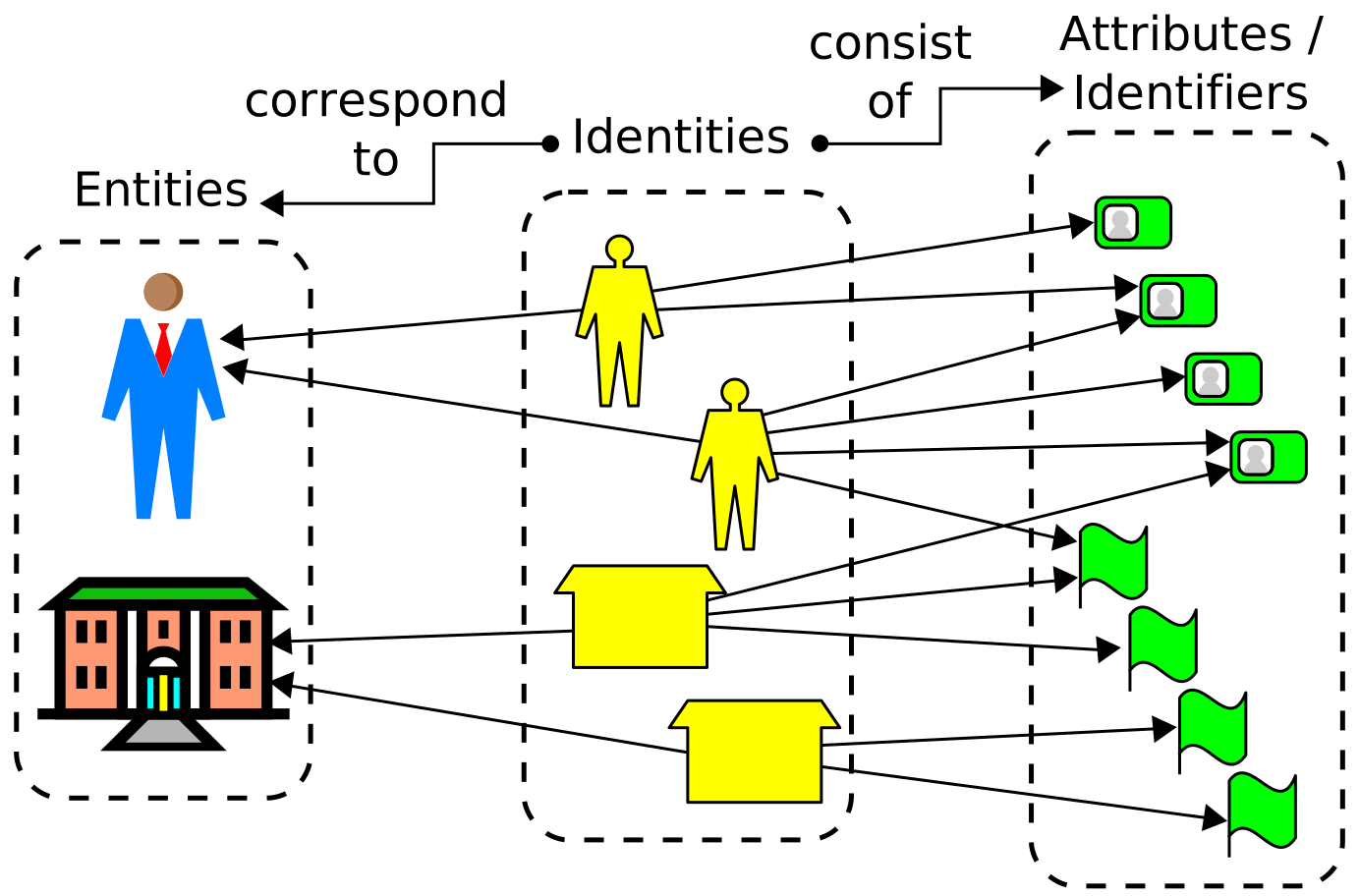
Defining KYC Zero in 2026
The term "KYC Zero" is frequently misunderstood as a call for unregulated anonymity. In reality, it represents a structural shift in how identity is verified within digital finance. Rather than eliminating oversight, this approach moves verification from centralized data hoarding to cryptographic proof. Users no longer submit raw identity documents to every service provider; instead, they prove specific attributes—such as age or residency—without revealing the underlying personal data.
This model, often referred to as Zero-Knowledge KYC, changes the architecture of compliance. A user receives a verifiable credential from a trusted issuer and stores it in their digital wallet. When interacting with a platform, they generate a zero-knowledge proof that confirms they meet specific criteria. The platform verifies the mathematical proof, not the personal document itself. This preserves privacy while maintaining the integrity of regulatory checks.
The distinction between "no-KYC" and "KYC Zero" is critical for legal and regulatory audiences. As noted in industry analysis, "no-KYC" often implies a complete lack of checks, which exists in a legal grey area. "KYC Zero," by contrast, is about privacy-preserving compliance. It ensures that identity predicates are verified without the unnecessary storage and exposure of sensitive personally identifiable information (PII). This reduces the attack surface for data breaches and aligns with the principle of data minimization.
The goal is not to bypass regulation but to modernize it. By shifting the burden of proof from document submission to cryptographic validation, the industry can achieve higher security standards and better user privacy. This approach supports regulatory goals while respecting individual rights, creating a more sustainable framework for digital identity in 2026.
The Architecture of Zero-Knowledge Proofs
Zero-Knowledge Proofs (ZKPs) represent a cryptographic protocol that allows one party, the prover, to demonstrate to a verifier that a specific statement is true without revealing any information beyond the validity of the statement itself. In the context of identity verification, this mechanism decouples the act of proving eligibility from the exposure of personal data. Rather than transmitting raw identity documents—such as passports or utility bills—to every service provider, users interact with verifiable credentials issued by trusted authorities. These credentials are stored in the user’s digital wallet, shifting control of sensitive data from centralized databases to the individual.
The technical utility of ZKPs lies in their ability to evaluate discrete identity predicates without exposing the underlying attributes. For example, a financial platform may require proof that a user is over 18 and resides in a specific jurisdiction to satisfy regulatory obligations. Using a ZK-proof, the user can generate a cryptographic token that confirms these conditions are met while keeping the actual birth date, full name, and precise address hidden from the verifier. This ensures that the compliance layer operates with the same cryptographic rigor as the asset layer, eliminating the need for service providers to store unencrypted personal identifiable information (PII).
This architectural shift addresses the fundamental security flaw of traditional KYC: the creation of centralized data honeypots. By keeping the underlying data off-chain and only publishing the verification result on-chain, ZK-KYC prevents large-scale data breaches that typically compromise user records. The verifier receives only a boolean confirmation of compliance, meaning that even if the verification ledger is compromised, the attacker gains no useful personal data. This approach aligns with privacy-preserving compliance standards, allowing institutions to meet anti-money laundering (AML) and know-your-customer requirements without becoming custodians of user identity.
Self-Sovereign Identity as the Foundation
Self-sovereign identity (SSI) shifts the architecture of identity verification from centralized repositories to decentralized protocols. At its core, this model relies on W3C-standardized Decentralized Identifiers (DIDs) and Verifiable Credentials (VCs). These standards enable users to hold cryptographically signed attestations in their personal wallets, rather than submitting raw identity documents to every service provider. This structural change is fundamental to achieving privacy-preserving compliance in a regulatory environment that increasingly scrutinizes data hoarding.
The mechanism operates through a three-party trust model involving the issuer, the holder, and the verifier. A trusted issuer, such as a government agency or licensed financial institution, issues a VC containing specific identity predicates. For example, a credential might confirm that a user is over the age of 18 or resides in a specific jurisdiction, without revealing their exact birthdate or home address. The user stores these credentials securely and presents them only when required by a verifier, such as a cryptocurrency exchange or DeFi protocol. This approach minimizes the attack surface by ensuring that no single entity maintains a comprehensive database of user identities.
This architecture directly addresses the "data honeypot" risk identified in traditional KYC processes. As noted in industry analysis, applying cryptographic rigor to the compliance layer allows platforms to verify eligibility without building centralized databases that attract malicious actors. Instead of transmitting sensitive personal information, the user generates a zero-knowledge proof that mathematically demonstrates they meet the verifier’s criteria. The verifier accepts the proof without ever seeing the underlying data. This method aligns with emerging regulatory expectations for data minimization, ensuring that compliance does not require the unnecessary collection of personal information.
While the technology provides robust privacy guarantees, its legal standing remains contingent on jurisdictional interpretation. Regulatory bodies are currently evaluating how these cryptographic proofs satisfy existing "Know Your Customer" obligations. The consensus among legal analysts is that SSI does not eliminate the need for identity verification but rather transforms how that verification is executed. By decoupling the identity claim from the identity data, SSI offers a pathway to regulatory compliance that respects user privacy rights while maintaining the integrity of the financial system.
Regulatory Compliance Without Data Honeypots
The central tension in digital identity regulation is the creation of data honeypots. Traditional KYC architectures require institutions to collect, store, and verify raw personally identifiable information (PII)—passports, selfies, and utility bills. This centralized accumulation of sensitive data creates a high-value target for cybercriminals, effectively turning compliance departments into liability centers. When breaches occur, the fallout extends beyond the institution to millions of users, undermining the very trust regulation seeks to protect.
Zero-Knowledge KYC resolves this by shifting the verification model from data possession to data validation. Instead of transmitting raw documents, users present cryptographic proofs generated from verifiable credentials issued by trusted authorities. These proofs allow institutions to satisfy regulatory requirements without ever accessing the underlying PII. For example, a user can prove they are over 18 or a resident of a specific jurisdiction without revealing their birthdate or home address. This approach aligns with the "data minimization" principle embedded in frameworks like the GDPR and emerging AI regulations.
| Feature | Traditional KYC | Zero-Knowledge KYC |
|---|---|---|
| Data Storage | Centralized PII databases | Local user wallet; no central PII |
| Breach Risk | High (massive honeypot) | Low (no sensitive data to steal) |
| Verification | Manual or OCR review of docs | Automated cryptographic validation |
| User Friction | High (document upload, waiting) | Low (instant proof generation) |
This architectural shift does not weaken compliance; it hardens it. By eliminating the incentive for hackers to target compliance databases, institutions reduce their exposure to regulatory fines and reputational damage. The verifier still receives a legally binding attestation that the user meets all necessary criteria, but the raw data remains under the user’s control. This ensures that regulatory obligations are met while neutralizing the primary motivation for large-scale identity theft.
Asset Performance Context
While the regulatory benefits are structural, the adoption of these technologies is often correlated with broader market sentiment in the crypto and fintech sectors. Investors and institutions monitoring this shift often track the performance of underlying assets to gauge market confidence in privacy-preserving infrastructure.
The stability of the asset layer often influences the pace of compliance layer innovation. When markets are volatile, the demand for efficient, low-friction onboarding increases, driving institutions toward solutions that reduce operational overhead without sacrificing regulatory adherence.
Market Landscape and Implementation
The market for KYC Zero solutions is shifting from a binary choice between full identity verification and total anonymity toward privacy-preserving compliance. While directories like KYCnot.me still catalog platforms that require no identity verification, the 2026 trend prioritizes zero-knowledge proofs (ZKPs) that allow users to prove specific identity predicates—such as age or residency—without exposing raw personal data. This architectural shift enables regulated fiat gateways to process transactions with lighter verification steps, reducing friction while maintaining regulatory alignment.
The economic signal for this transition is visible in the performance of privacy-focused infrastructure tokens. As institutional adoption of self-sovereign identity standards grows, the market capitalization of these specialized assets reflects a broader acceptance of decentralized compliance models over purely anonymous exchanges.
This evolution requires a nuanced understanding of regulatory boundaries. Using a no-KYC crypto exchange is not illegal in most countries, but it exists in a legal grey area shaped by local jurisdiction rules. Some regions explicitly prohibit using unregistered virtual asset service providers (VASPs). Consequently, the most viable implementations of KYC Zero are those that embed verification into the protocol layer, allowing users to hold verifiable credentials in their wallets and submit only the necessary cryptographic proofs to satisfy compliance requirements.
Frequently asked: what to check next
Is no-KYC activity illegal?
Using services that do not require identity verification exists in a legal grey area rather than being explicitly illegal in most jurisdictions. The regulatory risk depends heavily on local crypto regulations; some countries explicitly prohibit using unregistered Virtual Asset Service Providers (VASPs). Users must verify their local laws, as compliance is determined by jurisdiction rather than the technology itself.
What is zero knowledge KYC?
Zero-Knowledge KYC (ZK-KYC) shifts the verification architecture from data sharing to data proving. Instead of submitting raw identity documents to every application, users obtain a verifiable credential from a trusted issuer and store it in their wallet. They then generate a cryptographic proof that satisfies specific predicates—such as being over 18 or a resident of a specific country—without revealing the underlying personal data.
Can I use ZK proofs for regulatory compliance?
Yes. ZK-KYC is designed to enable privacy-preserving compliance. By proving specific identity attributes without exposing the full identity, users can satisfy Anti-Money Laundering (AML) and Know Your Customer (KYC) requirements while maintaining data minimization. This approach aligns with emerging regulatory frameworks that prioritize privacy alongside security.
No comments yet. Be the first to share your thoughts!