
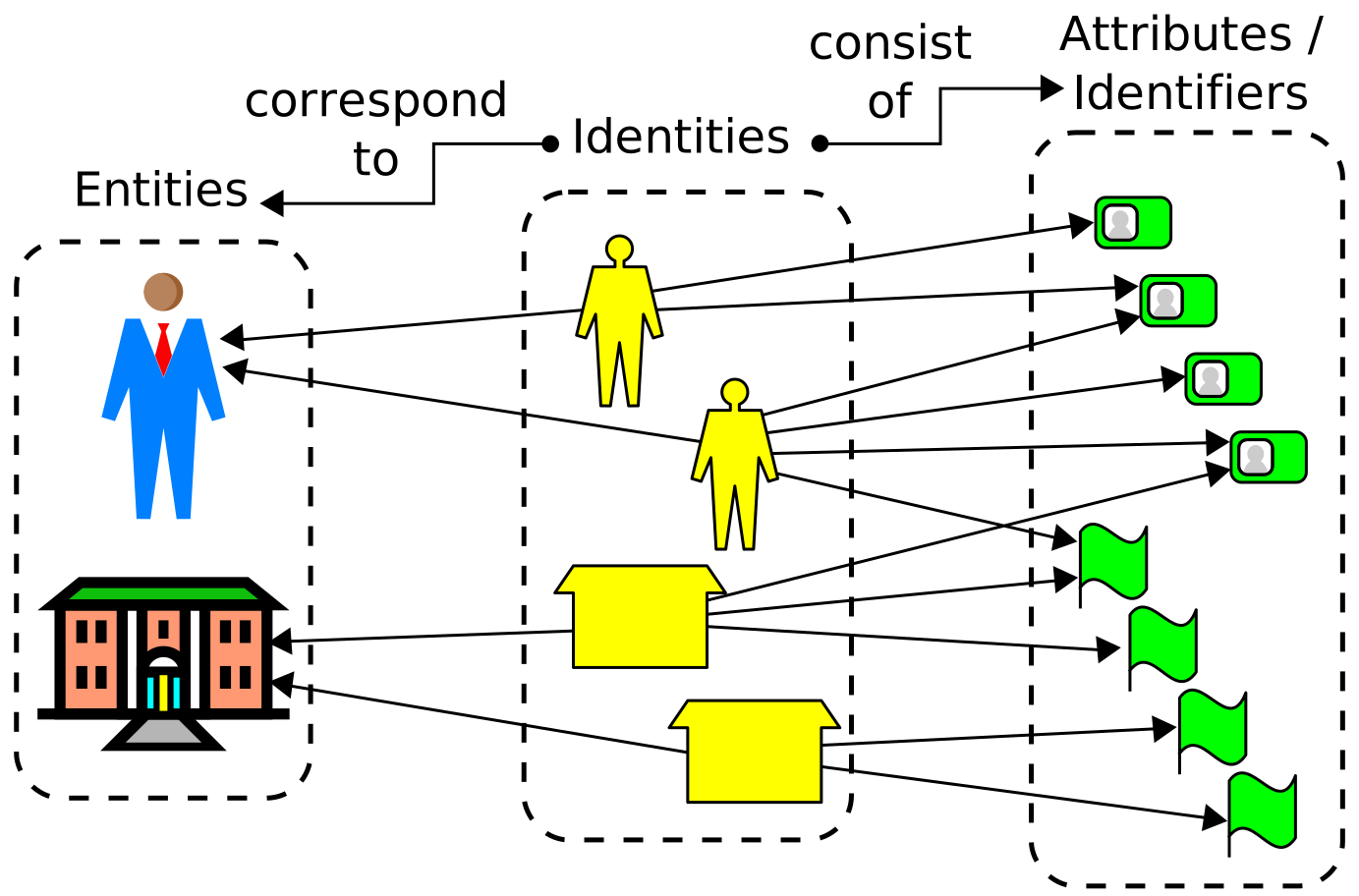
Why self-sovereign identity matters now
The digital identity landscape is shifting away from centralized control. Self-sovereign identity (SSI) gives individuals authority over their personal data, moving beyond the traditional model where corporations hold and profit from user information. In this framework, you decide who sees what and for how long.
Traditional KYC processes often require uploading sensitive documents to third-party servers, creating single points of failure for data breaches. SSI uses decentralized technologies to allow you to verify your age or residency without revealing your entire history. You present a cryptographically signed proof, not the underlying document itself.
This shift is becoming critical in 2026 as AI agents and automated services require reliable, privacy-preserving verification methods. SSI provides a standard for trust that doesn't rely on opaque APIs or centralized authorization servers. By controlling your own identity credentials, you reduce exposure to data leaks and unauthorized tracking.
The tools listed in this guide are built on these principles, offering concrete infrastructure for managing your digital self without surrendering control to a single entity.
Top self-sovereign identity platforms
The self-sovereign identity (SSI) market has matured from experimental pilots to deployable infrastructure. For developers and enterprises, the choice of platform dictates how easily verifiable credentials can be issued, stored, and verified across different ecosystems. The following tools represent the current standard for building decentralized identity solutions.
Hyperledger Aries
Hyperledger Aries is an open-source framework built on the Indy SDK. It provides the foundational protocols for SSI, allowing organizations to build custom wallet and issuer applications. It is the industry standard for high-compliance environments that require strict data sovereignty. Developers use Aries to create verifiable credential exchanges without relying on a centralized authority. It integrates well with other Hyperledger tools like Indy and Indy-VDR for ledger management.
Sovrin
Sovrin is a global public utility for self-sovereign identity. It operates a decentralized ledger that serves as the root of trust for verifying identities. Unlike private ledgers, Sovrin is maintained by a diverse network of stewards, ensuring no single entity controls the infrastructure. It is particularly useful for governments and large enterprises that need a trusted, neutral ground for identity verification. Sovrin provides the underlying network layer that many other SSI tools connect to.
Dock
Dock offers a developer-friendly platform for creating and managing digital credentials. It supports multiple blockchain networks, including Ethereum and Polygon, allowing teams to choose the right balance of cost and security. Dock’s SDKs simplify the process of issuing verifiable credentials and integrating them into existing applications. The platform is widely used for building digital loyalty programs, academic credentials, and professional certifications. Its flexibility makes it a strong choice for startups and mid-sized companies.
Comparison of SSI Platforms
Choosing the right platform depends on your technical requirements and compliance needs. The table below compares key features of the leading SSI infrastructure tools.
| Platform | Type | Ledger Support | Best For |
|---|---|---|---|
| Hyperledger Aries | Open Source Framework | Indy, Hyperledger Indy | Custom enterprise solutions |
| Sovrin | Public Utility | Sovrin Network | High-trust, neutral verification |
| Dock | SaaS/SDK Platform | Ethereum, Polygon | Rapid development, startups |
Essential SSI Development Tools
Building a self-sovereign identity system requires specific hardware and software components. The following tools are commonly used by developers to create and manage digital wallets and credentials.


As an Amazon Associate, we may earn from qualifying purchases.
How zero-knowledge proofs enable privacy
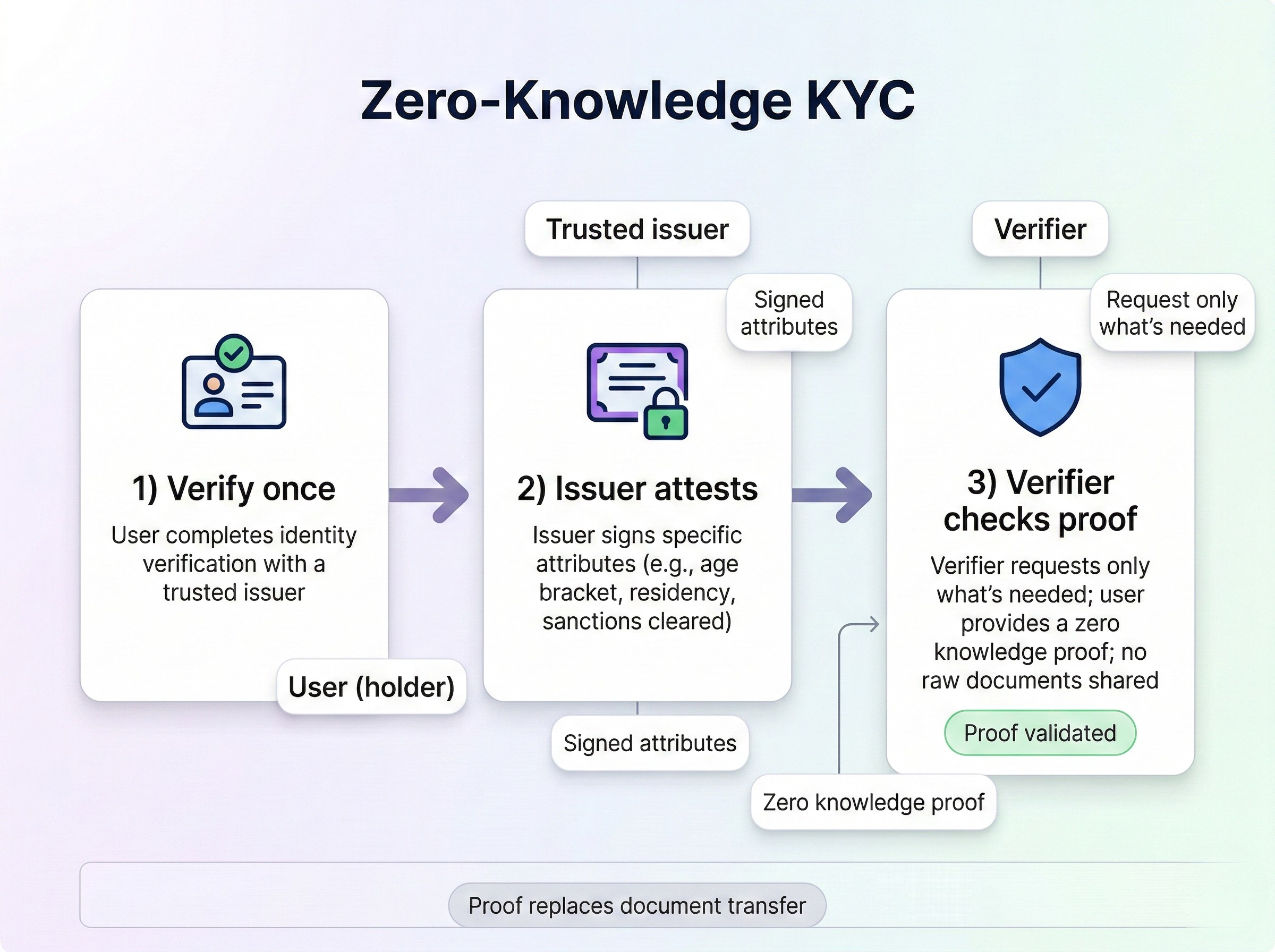
Self-sovereign identity platforms rely on zero-knowledge proofs (ZKPs) to solve the data exposure problem inherent in traditional KYC. A zero-knowledge proof allows a user to prove a statement is true without revealing the underlying data. In practice, this means a user can verify they are over 21 without sharing their birthdate, or prove they are a citizen of a specific country without disclosing their passport number.
This mechanism shifts the burden of verification from the service provider to the user's wallet. Instead of uploading a full government ID to a centralized database, the user generates a cryptographic proof. The verifier checks the proof against the issuer's public key. If the proof matches, the transaction is approved. The verifier learns nothing about the user's actual identity, only that the conditions were met.
The result is a self-sovereign identity system that minimizes data disclosure. Users retain control over what information is shared and with whom. Service providers reduce their liability by not storing sensitive personal data. This architecture prevents large-scale data breaches from compromising user identities, as there is no central database of credentials to steal.
Principles of self-sovereign identity
Self-sovereign identity (SSI) is a digital framework where individuals own and control their personal data. Unlike traditional models where identity is issued and managed by centralized authorities like governments or corporations, SSI shifts that authority to the user. This distinction is the foundation for tools that prioritize privacy and direct access.
The concept rests on three core tenets: existence, control, and access. These principles define how self-sovereign identity tools operate and why they differ from legacy digital ID systems.
Existence
In a self-sovereign identity system, a user must be able to exist in the digital world without relying on a third party to create their identity. The identity is not granted by an external entity; it is derived from the individual. This means your digital presence is independent, rooted in cryptographic keys that you hold, rather than a database record managed by a service provider.
Control
Control is the most critical differentiator. Users have ultimate authority over their digital identities and the personal data associated with them. You decide what information to share, with whom, and for how long. This eliminates the need to trust centralized intermediaries with your sensitive information, as you retain the power to revoke access at any time.
Access
Users must have easy and direct access to their own data. There are no gatekeepers or middlemen required to retrieve your credentials or identity proofs. This direct access ensures that your identity is always available when you need it, without waiting for permissions from external systems or dealing with complex recovery processes managed by third parties.
Getting started with decentralized identity
Adopting self-sovereign identity (SSI) shifts control from centralized databases to the user. To implement this, you must first select a wallet that supports the necessary standards. Look for tools compatible with W3C Verifiable Credentials and decentralized identifiers (DIDs). This ensures your digital identity remains portable across different platforms and services.
Next, verify that your chosen infrastructure supports interoperability. The ecosystem relies on shared protocols, so a tool isolated in one network offers limited utility. Check if the wallet integrates with existing credential issuers, such as government ID programs or educational institutions. This connectivity allows you to receive and store verifiable credentials immediately.
Once your wallet is configured, begin testing with low-stakes credentials. Issue a simple verification from a trusted source to confirm the signing and verification process works as expected. This step validates the security of your private keys and the reliability of the underlying blockchain or ledger. Successful testing builds the foundation for more complex identity scenarios.
Finally, establish a routine for managing your digital assets. SSI requires active participation, including backing up recovery phrases and revoking unused credentials. Treat your identity wallet like a physical wallet: keep it secure, but ensure you can access it when needed. Regular audits of stored credentials prevent digital clutter and maintain privacy.
Select a wallet that supports W3C Verifiable Credentials and DIDs. Prioritize tools that allow you to export your data, ensuring you are not locked into a single provider.
Confirm the wallet works with major credential issuers. Interoperability is essential for the self-sovereign identity model to function across different sectors like finance and healthcare.
Issue a basic verification from a trusted source. This validates the security of your private keys and confirms the signing process works correctly.
Back up your recovery phrase securely. Regularly review stored credentials to revoke access to services you no longer use.
Frequently asked questions about SSI
What are the principles of Self-Sovereign Identity?
Self-sovereign identity (SSI) rests on three core pillars. First is existence, meaning you can exist in the digital world without relying on a third-party provider like a social network. Second is control, giving you ultimate authority over your personal data and digital identity. Third is access, ensuring you have direct, easy access to your own credentials whenever you need them.
What is the meaning of self-sovereignty?
In the context of identity, self-sovereignty refers to individual sovereignty—the right of a person to have exclusive control over their own body, life, and data. It shifts ownership from centralized institutions back to the individual, treating digital identity as a personal asset rather than a service provided by a platform.
What is Self-Sovereign Identity plus AI?
Combining SSI with artificial intelligence allows AI agents to hold verifiable credentials. Instead of relying on opaque APIs, these agents can prove their identity, authorization, and compliance status just like a human user. This creates a trusted layer for AI interactions, ensuring that automated agents are who they claim to be.
No comments yet. Be the first to share your thoughts!