
What is zero-knowledge KYC?
Zero-knowledge KYC (ZK-KYC) is a verification method that allows you to prove you meet specific regulatory criteria without revealing your underlying personal data. Traditional KYC requires you to hand over sensitive documents like passports or utility bills to a central database. Zero-knowledge proofs change that dynamic by using cryptography to confirm a statement is true—such as you are over 18 or a resident of the EU—while keeping the actual details private.
This approach addresses a core tension in identity verification: regulators need to know who you are, but users want to minimize their digital footprint. By shifting from data collection to data validation, ZK-KYC reduces the risk of large-scale identity breaches. You are not sharing your entire identity; you are only sharing the specific proof required for compliance.
The technology relies on zero-knowledge proofs (ZKP), a cryptographic technique that allows one party to prove to another that they know a value or meet a condition without conveying any information apart from the fact that they know it. In the context of identity, this means a verifier can trust the output of the check without ever storing or seeing the raw biometric or document data.
Zero-knowledge kyc choices that change the plan
Adopting zero-knowledge KYC (ZK-KYC) introduces specific operational and technical tradeoffs. While the model shifts infrastructure from "collect and store" to "prove what's needed," it requires careful evaluation of computational costs and user experience friction [src-4]. The following factors determine whether the privacy benefits outweigh the implementation complexity for your specific use case.
Computational Overhead
Generating a zero-knowledge proof requires significant processing power compared to traditional verification. Unlike standard checks that simply validate a document image, ZK-KYC involves complex cryptographic operations. This can lead to higher server costs or slower onboarding times if not optimized. Users may also experience delays on mobile devices with limited processing capabilities.
Implementation Complexity
Building a ZK-KYC system demands specialized cryptographic expertise. Integrating zero-knowledge proof libraries into existing compliance workflows is non-trivial. Teams must manage both the proof generation client-side and the verification logic server-side. This complexity often increases initial development time and ongoing maintenance burdens compared to standard KYC providers.
Regulatory Acceptance
While promising, ZK-KYC is still evolving in terms of regulatory clarity. Some jurisdictions have clear frameworks for digital identity, while others remain cautious about cryptographic proofs as valid identification. Organizations must ensure their chosen zero-knowledge protocols meet specific local AML (Anti-Money Laundering) requirements. Early adopters may face scrutiny if regulators do not yet recognize specific proof types as compliant [src-1].
Data Minimization vs. Audit Trails
ZK-KYC excels at data minimization by revealing only the necessary facts (e.g., "over 18"). However, this can complicate audit trails for regulators who expect to see raw data logs. Organizations must design systems that preserve the privacy benefits while maintaining sufficient metadata for compliance audits. This balance requires careful architectural planning to avoid creating "black boxes" that regulators cannot inspect [src-3].
| Factor | Traditional KYC | Zero-Knowledge KYC |
|---|---|---|
| Data Storage | Stores raw PII and documents | Stores only cryptographic proofs |
| Verification Speed | Fast, simple document checks | Slower, requires proof generation |
| Privacy Exposure | High, full data exposure to verifier | Minimal, only criteria revealed |
| Regulatory Clarity | Well-established globally | Evolving, jurisdiction-dependent |
| Implementation Cost | Lower, off-the-shelf solutions | Higher, requires custom crypto dev |
How to Evaluate Zero-Knowledge KYC Providers
The 2026 regulatory landscape has shifted from theoretical privacy to enforceable compliance. When selecting a zero-knowledge KYC (ZK-KYC) provider, you must balance cryptographic rigor with legal admissibility. Use this framework to assess vendors and ensure your verification stack meets both technical and regulatory standards.

Ensure the provider’s proof circuits are mapped to specific jurisdictional requirements. A generic proof is insufficient if it cannot demonstrate compliance with local AML laws, such as the EU’s MiCA or US FinCEN guidelines. Ask for documentation showing how their system handles jurisdiction-specific age or residency checks without exposing raw PII.
Zero-knowledge proofs require significant computational power. Evaluate the time it takes for a user to generate and verify a proof. If the process takes longer than a few seconds, user drop-off rates will spike. Look for providers using optimized circuits or zk-SNARKs that balance security with speed.

Confirm that the provider never stores the underlying personal data used to generate the proof. The system should only retain the cryptographic proof and a status flag (e.g., "verified"). Any vendor storing raw identity documents alongside the ZK-proof is not truly privacy-preserving and introduces unnecessary liability.
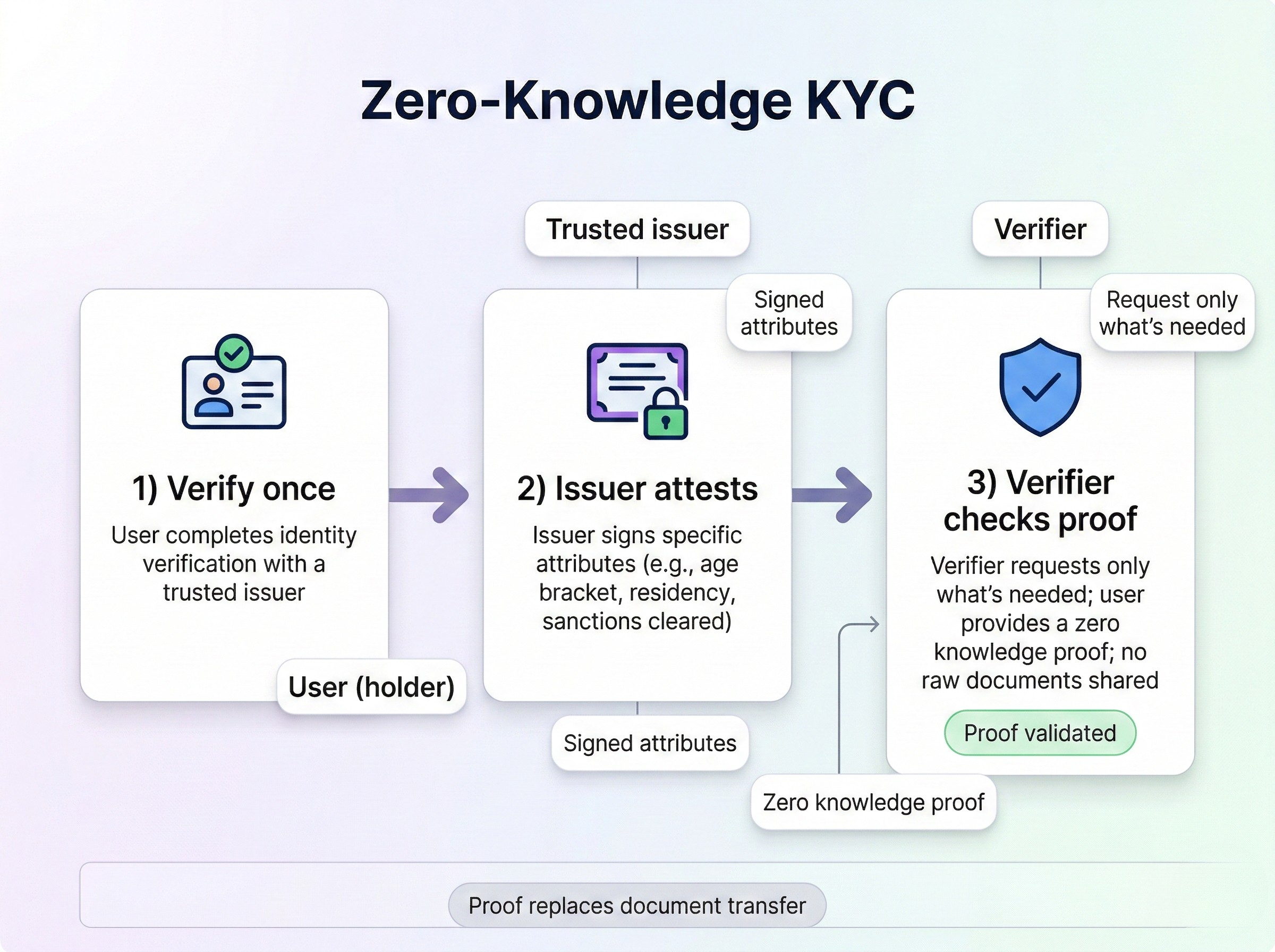
Your ZK-KYC solution must integrate with existing identity wallets and enterprise systems. Verify that the provider supports standard protocols like W3C Verifiable Credentials. This ensures that a user verified by Provider A can potentially use that proof with Partner B, reducing friction for cross-platform transactions.
-
Does the provider publish their cryptographic proof standards?
-
Can they demonstrate sub-5-second verification times?
-
Is there a clear data deletion policy for raw inputs?
-
Do they support W3C or other open identity standards?
Avoid the weak options
Use this section to make the The Rise of Zero-Knowledge KYC decision easier to compare in real life, not just on paper. Start with the reader's actual constraint, then separate must-have requirements from details that are merely nice to have. A practical choice should survive normal use, maintenance, timing, and budget. If a recommendation only works in an ideal situation, call that out plainly and give the reader a fallback path.
The simplest way to use this section is to write down the must-have criteria first, then compare each option against those criteria before weighing nice-to-have features.
Zero-knowledge kyc: what to check next
Zero-knowledge KYC (ZK-KYC) shifts identity verification from a "collect and store" model to a "prove what's needed" framework. This approach uses cryptography to confirm regulatory compliance without exposing sensitive personal data, addressing growing privacy concerns in 2026.
This transition marks a significant change in how financial and digital services handle identity. By prioritizing proof over possession, ZK-KYC offers a more secure alternative to traditional verification methods.
No comments yet. Be the first to share your thoughts!