
Defining KYC Zero in modern compliance
The term "KYC Zero" often triggers confusion, leading some to assume it implies a lack of regulation or a complete bypass of identity verification. This is incorrect. KYC Zero is not the absence of verification; it is a cryptographic method that replaces the storage of personal identity data with mathematical proofs.
In traditional compliance frameworks, financial institutions store sensitive documents—passports, utility bills, and biometric data—to verify identity. This creates a centralized target for data breaches and privacy violations. Zero-knowledge proofs (ZKPs) shift this model. Instead of storing the document, the system generates a cryptographic proof that a specific condition is met.
Regulatory trends indicate that compliance frameworks in the EU and US are increasingly focused on data minimization. Under regulations like eIDAS, the goal is to verify attributes without unnecessary data retention. KYC Zero aligns with this by allowing a platform to confirm a user is over 18 or resides in a specific jurisdiction without ever seeing their birth date or address. The verifier learns only the truth of the statement, not the underlying identity data.
How zero-knowledge proofs verify identity
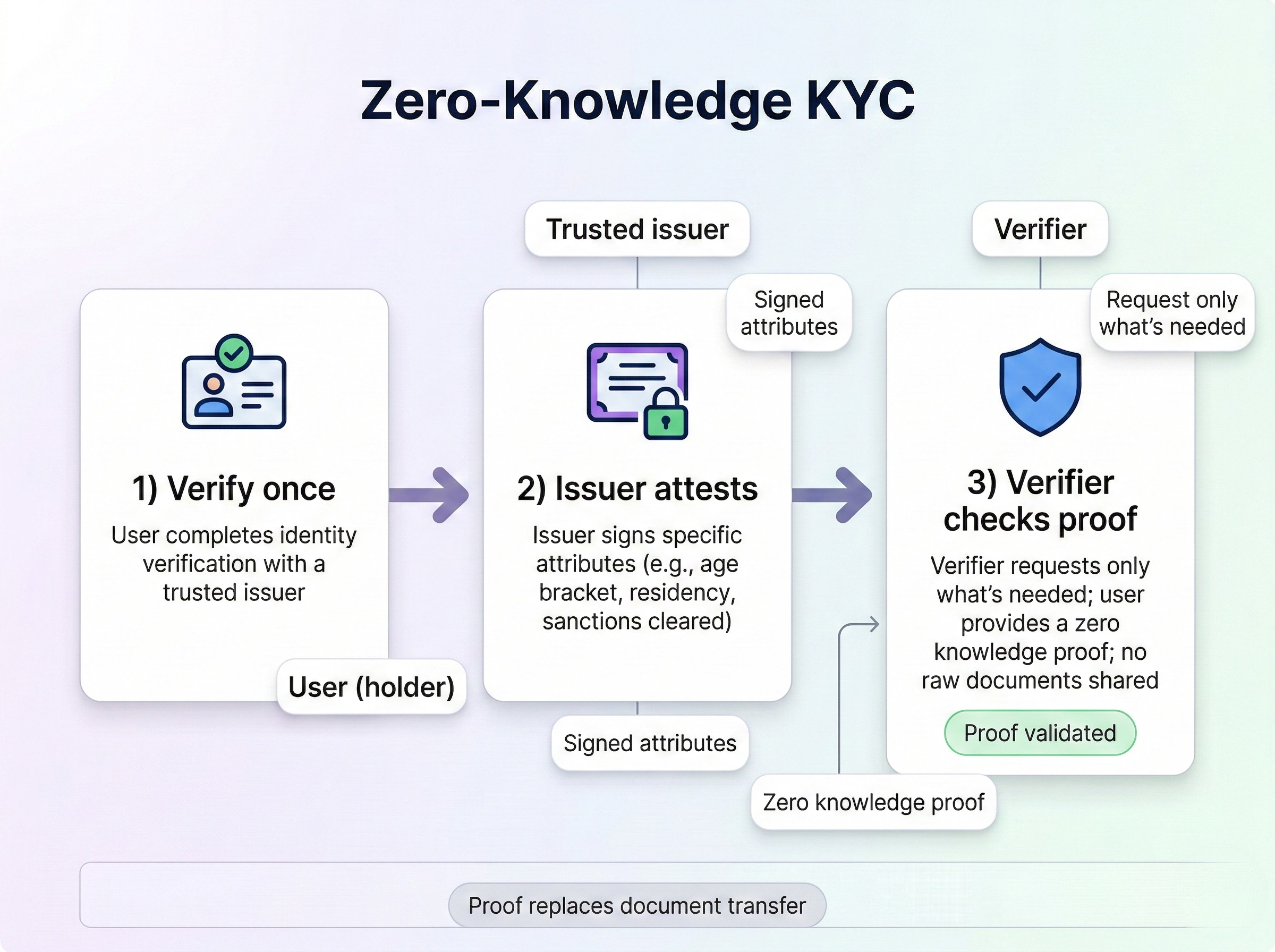
Traditional KYC processes operate on a "collect and store" model, requiring businesses to hold sensitive personal data like passports and utility bills. This approach creates significant liability, as centralized databases are prime targets for breaches. Zero-knowledge proofs fundamentally shift this dynamic by allowing users to prove they meet specific criteria without revealing the underlying raw data or documents.
In a ZKP system, the user generates a cryptographic proof that attests to their compliance status. For example, a user can prove they are over 18 or reside in a permitted jurisdiction without disclosing their exact birth date or home address. This mechanism aligns with regulatory trends indicating a move toward data minimization, where only the necessary verification outcome is shared, not the source documents themselves.
The technical process involves three main parties: the prover (the user), the verifier (the business or regulator), and often a trusted setup or oracle. The prover uses their private data to generate a proof. The verifier checks this proof against public parameters to ensure it is valid. If the proof is valid, the verifier accepts the claim—such as "this user is not on a blacklist"—without ever seeing the blacklist or the user's personal identity.
This architecture supports compliance frameworks in jurisdictions like the EU and the US by reducing the scope of data held by regulated entities. By eliminating the need to store PII, businesses lower their risk exposure while still satisfying anti-money laundering (AML) and know-your-customer obligations. The result is a verification process that is both privacy-preserving and legally robust.
Why enterprises adopt zero data retention
Enterprises are shifting away from traditional identity storage not merely as a technical upgrade, but as a strategic response to escalating liability and regulatory pressure. The core driver is the elimination of the "honeypot" effect: by storing no sensitive personally identifiable information (PII), organizations remove the primary incentive for cybercriminals to target their systems. This architectural shift fundamentally alters the risk calculus for financial institutions and regulated entities.
From a financial perspective, zero data retention significantly reduces the total cost of ownership for compliance infrastructure. Traditional KYC models require expensive, secure data centers, continuous encryption maintenance, and rigorous access controls for vast databases of customer records. By contrast, verifying identity through zero-knowledge proofs allows enterprises to validate claims—such as age, citizenship, or creditworthiness—without incurring the storage and safeguarding costs associated with holding that data. As noted in industry analyses of the ROI of zero data retention, this model lowers operational overhead while simultaneously reducing the potential financial impact of a breach.
Regulatory frameworks in the EU and other jurisdictions increasingly favor data minimization. The General Data Protection Regulation (GDPR) enshrines the principle that data should be "adequate, relevant and limited to what is necessary." Similarly, the eIDAS 2.0 regulation in the EU promotes privacy-by-design architectures. Compliance frameworks suggest that retaining large volumes of identity documents often violates these principles unless strictly justified and securely managed. Zero data retention aligns naturally with these mandates, allowing enterprises to demonstrate compliance by proving they do not hold the data in the first place.
The convergence of reduced breach liability, lower storage costs, and alignment with GDPR and eIDAS 2.0 creates a compelling business case. Enterprises are no longer viewing identity verification solely as a gatekeeping function, but as a privacy-preserving service that protects both the customer and the organization from the catastrophic costs of data exposure.
Compliance challenges for KYC zero
Implementing zero-knowledge proofs in identity verification shifts the regulatory burden from data custodians to cryptographic validators. While the technology promises privacy, it introduces specific friction points for anti-money laundering (AML) frameworks. Compliance is not automatic; it requires rigorous integration with trusted data sources and alignment with existing jurisdictional mandates.
The primary challenge lies in the "per-decision defensibility" test. Regulators in the EU and US expect auditable trails for every compliance decision. Zero-knowledge systems must prove that a verification was valid without exposing the underlying personal data. This creates a tension between privacy preservation and regulatory transparency. The cryptographic proof itself must be verifiable by authorized third parties.
Trusted oracles like Chainlink DECO are essential for bridging off-chain identity data with on-chain verification. These oracles fetch real-world credentials—such as passport validity or age—and generate zero-knowledge proofs. Without this trusted bridge, the system cannot confirm that the input data is legitimate. The integrity of the ZK-KYC process depends entirely on the security and reliability of these oracle networks.
Jurisdictional differences further complicate deployment. The EU’s eIDAS regulation and the US’s Bank Secrecy Act have distinct requirements for identity verification. A zero-knowledge solution must be designed to satisfy the strictest applicable standard. This often means creating modular verification protocols that can adapt to different legal definitions of "verified identity."
Timeline of privacy-preserving identity shifts
Foundational research established the mathematical possibility of proving identity without sharing raw data. Academic papers demonstrated that zero-knowledge proofs could theoretically bypass the need for centralized databases holding sensitive personal information.
The European Union’s eIDAS 2.0 regulation introduced the European Digital Identity Wallet, creating a legal framework for self-sovereign identity. This shift moves control from institutions back to individuals, setting a precedent for global regulatory standards.
Financial institutions and tech platforms are now integrating zero-knowledge KYC to reduce liability. This phase prioritizes verifying criteria—such as age or residency—without storing the underlying documents, significantly lowering the risk of large-scale data breaches.
Checklist for evaluating KYC Zero solutions
Assessing a zero-knowledge identity provider requires verifying that cryptographic claims align with regulatory expectations. Privacy-preserving systems must still satisfy auditability and jurisdictional requirements.
-
Auditability of proofs: Ensure the system allows verifiable proof generation without exposing raw data.
-
Oracle trustworthiness: Verify that off-chain identity attestations come from reputable, regulated sources.
-
Jurisdictional compliance: Confirm the solution meets specific requirements in the EU (eIDAS 2.0) or US (state-level privacy laws).
-
Data retention policies: Ensure the provider operates on a zero-retention model, deleting personal data post-verification.
common questions on identity verification
Clarity around identity protocols reduces friction in onboarding. The following answers address frequent inquiries regarding Know Your Customer (KYC) legitimacy, consequences of non-compliance, and emerging applications in artificial intelligence.
Regulatory trends indicate that while KYC is standard, zero-knowledge proofs offer a method to satisfy these requirements without storing raw identity data centrally, thereby reducing liability for data breaches.
No comments yet. Be the first to share your thoughts!