
What KYC Zero Actually Means
The term "KYC Zero" is frequently misunderstood as a mechanism for bypassing regulatory requirements or eliminating identity verification entirely. In reality, it refers to a specific cryptographic architecture: verification without data retention. This approach allows organizations to confirm that a user meets specific compliance criteria without ever storing, processing, or retaining the underlying personal data that proves it.
Under traditional Know Your Customer (KYC) frameworks, institutions collect sensitive documents—such as passports, utility bills, and facial scans—to verify identity. This creates significant liability. Under regulations like the European Union’s General Data Protection Regulation (GDPR), holding such data imposes strict obligations regarding storage, security, and the right to erasure. If a breach occurs, the exposure is total. KYC Zero shifts this burden by using Zero-Knowledge Proofs (ZKPs) to validate facts rather than identities.
A Zero-Knowledge Proof allows a prover to demonstrate to a verifier that a statement is true without revealing any information beyond the validity of the statement itself. In a compliance context, this means a user can prove they are over 18, a resident of the European Union, or not on a sanctions list, without revealing their name, date of birth, or address. The verifier receives a cryptographic guarantee that the predicate is true, satisfying regulatory obligations while leaving the user’s personal data with the user.
This distinction is critical for legal and compliance frameworks. For instance, the eIDAS regulation in the EU establishes standards for electronic identification and trust services. It focuses on the assurance level of the identification process rather than the indefinite storage of biometric or document data. By decoupling the act of verification from the act of data retention, KYC Zero aligns with the principle of data minimization—a core tenet of modern privacy law. The organization retains only the cryptographic proof of compliance, not the personal data itself, thereby reducing regulatory exposure and enhancing user privacy simultaneously.
How zero-knowledge proofs verify identity
Zero-Knowledge Proof KYC (ZK-KYC) allows a user to demonstrate compliance with regulatory predicates without exposing the underlying personal data. This mechanism shifts the verification model from data collection to data validation, ensuring that businesses can satisfy legal obligations while minimizing the risk of holding sensitive personally identifiable information (PII). The process operates through a structured sequence of cryptographic interactions.

The individual initiates the process by interacting with a trusted verifier, such as a national digital identity provider or a licensed KYC operator. Using a zero-knowledge protocol, the user’s device creates a mathematical proof that confirms a specific predicate—for example, "the user is over 18" or "the user resides in the European Economic Area." This proof is generated locally, ensuring that the raw data, such as the exact birth date or home address, never leaves the user’s control or is transmitted to the relying party.
The relying party, such as a financial institution or platform, receives the cryptographic proof and validates it against public parameters defined by the protocol. This validation step confirms that the proof is mathematically sound and was issued by a trusted source. Under frameworks like the EU’s eIDAS regulation, this verification ensures that the digital signature and the attested claims meet the required assurance levels, allowing the business to confirm compliance without processing the raw PII.
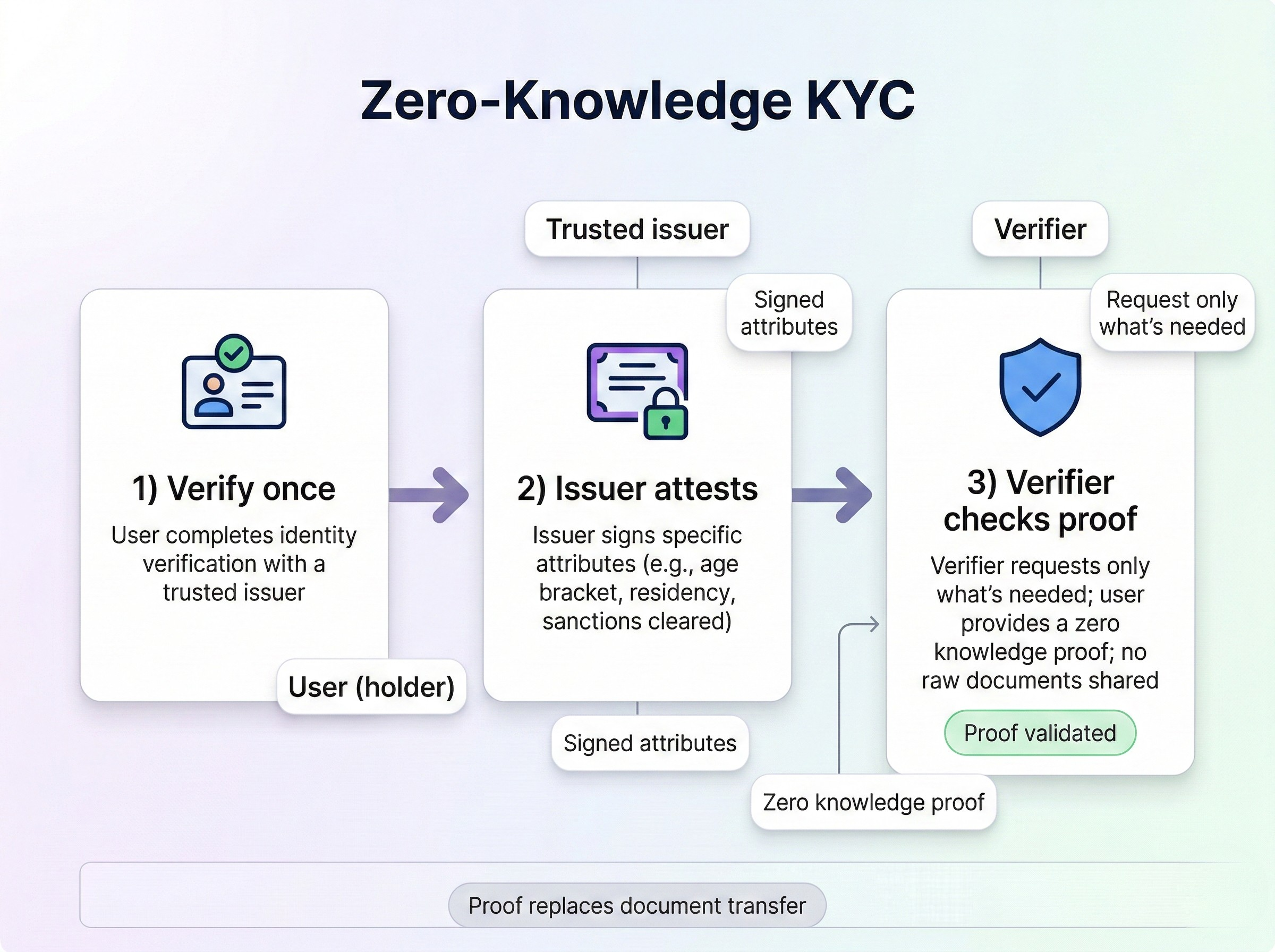
Once the proof is validated, the system grants the user access to the service or transaction. Because the relying party only received a boolean result or a minimal attribute claim (e.g., "age > 18") rather than the full dataset, the risk of data breaches is significantly reduced. This approach aligns with GDPR’s data minimization principle, which mandates that only data strictly necessary for the purpose should be processed, thereby limiting the scope of potential regulatory penalties.
This architecture effectively decouples identity verification from data retention. By relying on cryptographic proofs rather than document storage, organizations can maintain audit trails that satisfy legal requirements while adhering to privacy-by-design standards. The result is a compliance framework that is both secure and respectful of individual privacy rights.
Why Regulated Entities Prefer Zero-Knowledge Compliance
For financial institutions and licensed crypto platforms, the traditional model of collecting and storing personally identifiable information (PII) presents a significant liability. Under frameworks like the General Data Protection Regulation (GDPR) and the eIDAS regulation, data minimization is not merely a best practice but a legal requirement. Zero-Knowledge Proofs (ZKPs) align directly with these mandates by allowing entities to verify compliance without retaining the underlying sensitive data.
Reduced Liability and Breach Risk
The most immediate benefit for regulated entities is the elimination of the "data honeypot." When a platform stores vast amounts of identity documents, it becomes a primary target for cybercriminals. By shifting to a zero-data-retention model, institutions drastically reduce their attack surface. If a breach occurs, there is no customer database to steal. This approach mitigates the financial and reputational risks associated with data leaks, which can trigger massive regulatory fines under GDPR’s strict penalty structures.
Alignment with Data Minimization Principles
ZKPs allow institutions to satisfy Know Your Customer (KYC) and Anti-Money Laundering (AML) obligations while adhering to the principle of data minimization. Instead of storing full passports or utility bills, the platform verifies cryptographic proofs of predicates—such as "the user is over 18" or "the user resides in the EU." This ensures that only the data strictly necessary for the compliance decision is processed, and even that data is ephemeral, leaving no permanent record of the user’s identity documents. This structure simplifies audit trails and reduces the burden of data retention policies.
Compliance Advantages Checklist
Adopting this framework offers specific operational benefits for compliance teams:
- Audit Trail Integrity: Verifiable proofs provide clear, immutable evidence of compliance checks without exposing raw PII.
- Simplified Data Retention: No need to manage long-term storage of sensitive identity documents reduces regulatory overhead.
- Lower Breach Impact: In the event of a security incident, the absence of stored PII limits exposure and potential fines.
- Cross-Border Efficiency: Predicates like residency or age can be verified against local laws without transferring full identity records across jurisdictions.
Regulatory Landscape and eIDAS 2.0
The deployment of KYC Zero in 2026 occurs within a tightening regulatory framework that increasingly demands both data minimization and verifiable identity. The European Union’s eIDAS 2.0 regulation, which establishes the legal basis for digital wallets and decentralized identifiers, provides the structural foundation for this shift. Under eIDAS 2.0, qualified electronic identification means must support selective disclosure, allowing users to prove specific attributes without revealing the underlying personal data. This legal mandate aligns directly with the cryptographic capabilities of zero-knowledge proofs, creating a compliant pathway for privacy-preserving verification.
Compliance teams must reconcile these technical capabilities with the Anti-Money Laundering Directive (AMLD). While AMLD imposes strict customer due diligence requirements, it does not prescribe the method of verification. Zero-knowledge proofs satisfy the core requirement of verifying identity attributes—such as age, residency, or sanction status—by generating a cryptographic proof of compliance. For example, a financial institution can accept a proof that a user is over 18 and resides in the EU, without ever storing the user’s date of birth or address. This approach reduces data liability and minimizes the attack surface for breaches, addressing the tension between regulatory scrutiny and data protection.
The interaction between GDPR, eIDAS 2.0, and AMLD creates a complex but navigable landscape. GDPR’s principle of data minimization is reinforced by eIDAS 2.0’s technical standards, while AMLD ensures that the verification process remains robust against illicit activity. The result is a regulatory environment where zero-knowledge proofs are not merely an optional privacy feature, but a legally viable method for conducting compliant KYC operations. Organizations adopting this technology must ensure their proof systems are auditable and meet the specific jurisdictional requirements for identity assurance levels defined in eIDAS 2.0.
Real-World Implementation Challenges
While zero-knowledge proofs offer a theoretical solution to data minimization, deploying them in regulated financial systems introduces significant engineering and compliance hurdles. The transition from cryptographic proof to legal acceptance requires solving three distinct problems: computational overhead, lack of standardization, and the necessity of trusted initial issuance.
Computational Overhead and Latency
Zero-knowledge proofs, particularly zero-knowledge succinct non-interactive arguments of knowledge (zk-SNARKs), are computationally intensive. Generating a proof requires substantial processing power, which can create latency issues for real-time onboarding flows. For a compliance officer evaluating a vendor, a three-second delay per user verification is often unacceptable compared to traditional database lookups that return results in milliseconds. While proof verification is fast, the generation phase remains a bottleneck for high-throughput platforms.
Standardization Gaps
A primary barrier to adoption is the absence of universal standards for ZK-proof structures. Currently, different protocols use different cryptographic primitives, making it difficult for a single compliance provider to issue proofs that are universally accepted across various banking partners. This fragmentation forces institutions to build custom integration layers for each new partner, increasing maintenance costs. Until industry bodies establish a common format for regulatory predicates, interoperability will remain limited.
The Trusted Initialization Problem
Zero-knowledge proofs do not verify truth; they only verify that a statement is true if the underlying data is true. This creates a dependency on the initial data source, known as the trusted setup or oracle problem. If a user provides a falsified passport image to the initial verification layer, the resulting ZK-proof will cryptographically confirm the lie. Therefore, the initial identity verification step must still rely on trusted, human-reviewed processes or government-issued digital credentials, such as those defined under the European eIDAS regulation. The technology shifts where data is stored, but it does not eliminate the need for initial trust anchors.
Frequently Asked Questions About KYC Zero
Is KYC Zero legal under current regulations?
The legality of zero-knowledge proof (ZKP) systems depends on how they align with existing regulatory frameworks. Under the EU’s eIDAS regulation, qualified electronic signatures and identities are recognized, and ZKPs can technically support these requirements by proving attributes without exposing underlying data. For GDPR compliance, ZKPs offer a privacy-preserving alternative by minimizing data collection, adhering to the principle of data minimization. However, businesses must ensure that the ZKPs used are audited and meet the specific evidentiary standards required by their jurisdiction.
How do ZKPs handle Anti-Money Laundering (AML) checks?
AML regulations require businesses to verify the source of funds and screen for sanctions. ZKPs can facilitate this by allowing a user to prove they are not on a sanctions list or that their funds originate from a compliant source, without revealing their full transaction history or identity to the verifier. For example, a user can generate a proof that they are over 18 and a resident of a specific country, satisfying KYC requirements while keeping their actual date of birth and address private. This maintains the integrity of AML checks while enhancing user privacy.
What happens if the zero-knowledge proof fails or is rejected?
If a ZKP fails to verify, the transaction or access request is denied. This is similar to a traditional KYC process where incorrect or missing information leads to rejection. However, with ZKPs, the user does not necessarily know if the proof failed due to a technical error or because the predicate (e.g., age, residency) was not met. To address this, systems often provide generic error messages that guide the user to re-attempt the proof generation or provide additional verification steps. This ensures that the verification process remains secure and compliant without exposing sensitive data during the failure state.
Can ZKPs replace traditional KYC entirely?
While ZKPs offer significant privacy benefits, they are not yet a complete replacement for traditional KYC in all contexts. Regulatory bodies still require certain levels of identity verification that may not be fully satisfied by ZKPs alone, especially in high-risk transactions. ZKPs are best viewed as a complementary technology that enhances the privacy and security of existing KYC processes. Businesses should consider a hybrid approach, using ZKPs for sensitive data verification while maintaining traditional methods for initial identity registration.
How do ZKPs impact user experience compared to traditional KYC?
ZKPs can improve user experience by reducing the amount of personal data users need to submit. Instead of uploading photos of passports and utility bills, users can simply prove specific attributes, such as being over 18 or a resident of a particular country. This streamlined process reduces friction and increases conversion rates. However, the technical complexity of generating ZKPs can be a barrier for some users, requiring user-friendly interfaces and clear instructions to ensure a smooth experience.
No comments yet. Be the first to share your thoughts!