
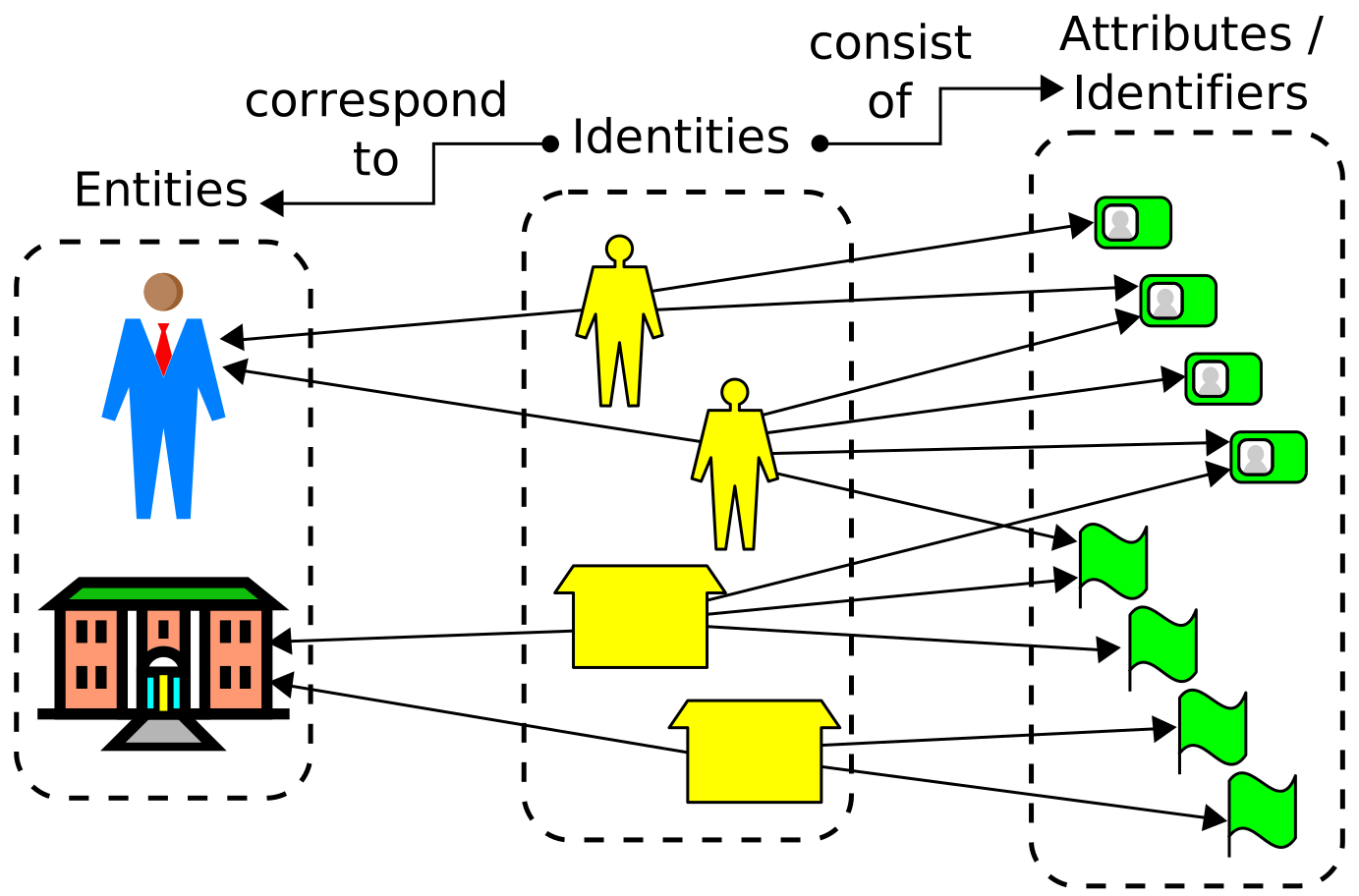
What is KYC Zero
The term "KYC Zero" is frequently misunderstood as a call for regulatory abandonment. In reality, it describes a structural shift from data collection to data minimization. Rather than requiring users to submit raw identity documents—such as passports or driver's licenses—to every service provider, this model relies on cryptographic proofs to verify compliance without exposing sensitive personal information.
This approach is anchored in zero-knowledge proofs (ZKPs), a cryptographic method that allows one party to prove a statement is true without revealing the underlying data. For example, a user can prove they are over 18 or reside in a specific jurisdiction without disclosing their exact birthdate or home address. As noted in industry analyses, this changes the architecture of verification: instead of sending raw identity documents to every app, the user receives a verifiable credential from a trusted issuer and keeps it in their wallet.
From a legal standpoint, this model aligns with emerging regulatory frameworks like the EU's eIDAS 2.0, which promotes self-sovereign identity. The goal is not to eliminate oversight but to reduce the attack surface for data breaches. By minimizing the amount of personal data held by intermediaries, organizations can maintain compliance with AML directives while significantly lowering the risk of identity theft and unauthorized data sharing.
How zero-knowledge proofs work in compliance
Zero-knowledge proofs (ZKPs) allow a user to demonstrate compliance with regulatory requirements without exposing the underlying personal data. In a standard KYC process, a user submits a passport or driver’s license to a verifier, who then stores that sensitive information. Under a zero-knowledge framework, the user retains their identity documents in a secure digital wallet. When a service needs to verify eligibility, the user generates a cryptographic proof that confirms the data meets specific criteria—such as being over 18 or residing in a permitted jurisdiction—without revealing the actual document content.
This mechanism shifts the verification model from data collection to data validation. The verifier receives a mathematical guarantee that the statement is true, rather than the raw identity documents themselves. This approach aligns with the principles of data minimization, a core tenet of privacy regulations like the GDPR and frameworks such as eIDAS, which mandate that personal data be limited to what is strictly necessary for the purpose of processing. By using ZKPs, financial institutions can satisfy Anti-Money Laundering (AML) obligations while significantly reducing their liability for data breaches.
The process involves three main parties: the user (prover), the identity issuer (such as a government or accredited KYC provider), and the service provider (verifier). The issuer validates the user’s identity once and issues a verifiable credential. The user then uses this credential to generate a zero-knowledge proof for the verifier. The verifier checks the proof against public cryptographic parameters. If the proof is valid, the verifier accepts the user as compliant, having never seen the original identity document. This architecture ensures that the user’s sensitive information remains under their control, mitigating the risk of centralized data honeypots.
Self-Sovereign Identity Architecture
Self-sovereign identity (SSI) shifts the custodial responsibility of personal data from centralized intermediaries to the individual. This architectural model relies on two core cryptographic primitives: decentralized identifiers (DIDs) and verifiable credentials. In this framework, a user does not submit raw identity documents to every service provider. Instead, they hold a cryptographically signed credential from a trusted issuer—such as a government or licensed financial institution—in a digital wallet. The user then presents only the necessary proof to the verifier, maintaining control over what data is shared and when.
The mechanism enabling this privacy-preserving compliance is the zero-knowledge proof (ZKP). ZKPs allow a user to prove they meet specific regulatory criteria without revealing the underlying data. For example, a user can prove they are over 18 or reside in a sanctioned jurisdiction without disclosing their exact birth date or home address. This capability aligns with the "data minimization" principle embedded in regulations like the EU’s eIDAS 2.0 and the US Anti-Money Laundering Act (AMLA), which increasingly favor verification methods that limit data exposure.
Traditional KYC processes create centralized databases that serve as high-value targets for breaches. By contrast, SSI architectures distribute data ownership. A breach at a service provider does not compromise the user’s identity data, as that data remains encrypted in the user’s wallet. This shift reduces liability for institutions and restores user agency, ensuring that compliance does not come at the cost of total data transparency.
| Feature | Traditional KYC | Self-Sovereign Identity |
|---|---|---|
| Data Ownership | Service Provider | User |
| Breach Risk | High (Centralized Database) | Low (Distributed Wallets) |
| Verification Method | Raw Document Submission | Cryptographic Proof (ZKP) |
| Regulatory Alignment | Static Compliance | Dynamic, Minimal Disclosure |
Regulatory Landscape in 2026
The legal environment for self-sovereign identity is shifting from cautious observation to structural integration. The European Union’s eIDAS 2.0 regulation provides the first comprehensive framework for digital identity wallets, establishing a baseline for how verifiable credentials can be issued and recognized across borders. This regulation does not merely permit self-sovereign models; it actively encourages them by mandating that member states offer citizens a secure, personal data room for their identity attributes.
However, the intersection of eIDAS 2.0 and the new Anti-Money Laundering Directive (AMLA) creates a complex compliance environment. AMLA places a heavy burden on digital asset service providers to monitor transactions in real time. The challenge for KYC Zero models is demonstrating that zero-knowledge proofs (ZKPs) satisfy these monitoring requirements without handing over raw personal data. The regulatory test is no longer about whether the technology works, but whether the audit trail is defensible.
This leads to the "per-decision defensibility" standard. Regulators are increasingly looking for systems where each transaction or access request can be independently verified against compliance rules without exposing the user’s entire history. A successful model must prove that the verification logic is transparent and auditable, even if the underlying data remains encrypted. This approach aligns with the principle of data minimization, ensuring that only the necessary information is shared for each specific interaction.
The path forward requires a balance between strict compliance and user privacy. Providers that can demonstrate this balance through rigorous cryptographic proofs and clear audit trails will likely find favor with regulators. Those that rely on obscurity or weak verification methods will face increasing scrutiny. The goal is to create a system where compliance is built into the protocol, not bolted on as an afterthought.
Real-World Implementation Examples
The transition from theoretical zero-knowledge proofs to regulated financial infrastructure requires concrete implementation. Current deployments focus on two primary architectures: decentralized oracle networks that validate data integrity, and enterprise-grade verification layers that issue verifiable credentials.
Chainlink’s Deco protocol exemplifies the oracle approach. It allows users to prove compliance with specific regulatory thresholds—such as being over 18 or residing in a permitted jurisdiction—without exposing the underlying personal data to the requesting service. This mechanism ensures that financial institutions can satisfy Anti-Money Laundering (AML) directives while maintaining the privacy guarantees inherent to decentralized systems.
Enterprise platforms such as Zyphe demonstrate the credential issuance model. In this workflow, a trusted issuer verifies the user’s identity once and issues a verifiable credential. The user then presents a zero-knowledge proof of this credential to various services. This reduces the attack surface for data breaches, as sensitive identity documents are not repeatedly transmitted across the internet.
These implementations are not merely technical experiments; they are evolving into the standard for compliance in digital finance. By shifting the verification burden from centralized databases to cryptographic proofs, platforms can better manage the complex regulatory landscape of 2026.
Frequently asked: what to check next
Is no-KYC activity illegal?
The legality of operating without identity verification depends entirely on the jurisdiction. In many regions, no-KYC services operate in a regulatory gray area because laws have not explicitly banned them. However, this position is fragile. As regulatory frameworks like the EU’s MiCA and the US AMLA evolve, compliance requirements are tightening. Relying on anonymity without legal counsel carries significant risk as enforcement actions increasingly target platforms that fail to implement standard anti-money laundering protocols.
What is zero-knowledge KYC?
Zero-knowledge KYC (ZK-KYC) shifts the verification architecture from document submission to cryptographic proof. Instead of uploading sensitive IDs to every service provider, users obtain a verifiable credential from a trusted issuer. They then use zero-knowledge proofs to demonstrate they meet specific criteria—such as being over 18 or residing in a permitted country—without revealing their underlying personal data. This preserves privacy while satisfying regulatory obligations.
How do self-sovereign identities work legally?
Self-sovereign identity (SSI) relies on decentralized identifiers (DIDs) and verifiable credentials. Legally, the issuer (such as a government or bank) attests to the truth of the data. The user holds the credential in a digital wallet and presents it to verifiers. This structure reduces liability for service providers by limiting the amount of personal data they store, aligning with privacy-by-design principles advocated in frameworks like eIDAS 2.0.
No comments yet. Be the first to share your thoughts!