
In 2026, the demand for no KYC crypto debit cards surges as privacy-conscious users seek seamless ways to spend Bitcoin, USDT, or stablecoins on groceries, bills, and daily essentials without surrendering personal data. Global regulations have tightened, shrinking truly anonymous options, yet innovative providers persist, offering virtual and physical cards that prioritize financial sovereignty. This guide ranks the top 10 by fees, spending limits, and privacy strength, drawing from current market analyses.

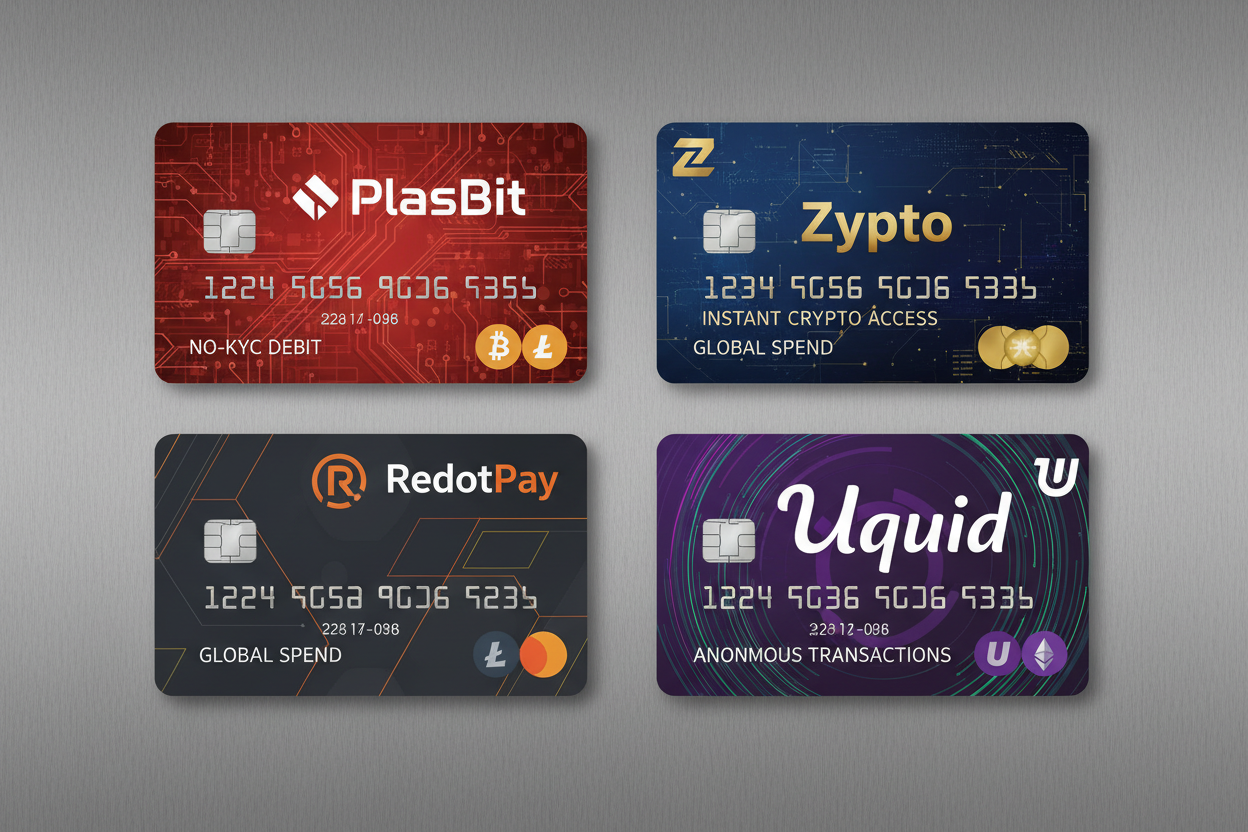
Regulatory pressures from AML and CTF mandates have culled many players, leaving a select few that balance compliance with user anonymity. Providers like PlasBit Card and Zypto Card stand out for minimal verification, often just an email, enabling instant issuance. Users report smooth integration with wallets for topping up via Solana or Ethereum, ideal for anonymous crypto card everyday spending.
Why No-KYC Debit Cards Excel for Privacy-Focused Daily Transactions
Traditional banks demand exhaustive ID checks, exposing spending habits to surveillance. No-KYC alternatives bypass this, converting crypto to fiat at point-of-sale without traces. Consider RedotPay Card: it supports high-volume loads from USDT on Tron, with daily limits exceeding $10,000 in user tests. Fees hover under 1-2%, far below legacy fintechs. For bills or fuel, these cards mask origins, preserving privacy crypto debit card integrity.
Laso Finance Card ranks high for stablecoin preload via USDC, appealing to conservative spenders. Its prepaid model avoids credit checks, and virtual issuance takes minutes. SolCard leverages Solana’s speed for near-instant top-ups, minimizing gas costs that plague Ethereum-based rivals.
Top Contenders Ranked: Fees, Limits, and Privacy Breakdown
Ranking prioritizes low fees, generous limits, and robust privacy. PlasBit Card leads with zero issuance fees and $20,000 monthly caps, supporting BTC to Monero. Zypto Card follows, issuance at $6, daily spend $2,000, minimal data required. RedotPay Card offers physical options for $50, unlimited virtual reloads.
| Card | Issuance Fee | Daily Limit | Privacy Level |
|---|---|---|---|
| PlasBit Card | $0 | $5,000 | High (email only) |
| Zypto Card | $6 | $2,000 | High |
| RedotPay Card | $50 physical | $10,000 | Medium-High |
| Uquid Card | $10 | $3,000 | High |
| Laso Finance Card | $0 | $5,000 | High |
Uquid Card shines for multi-chain support, including Polygon for cheap transfers, while Helio Pay Card integrates DeFi yields pre-spend. BingCard and KemyCard cater to niche users with XMR focus, enhancing untraceability. Blackcatcard closes the list with aggressive cashback, offsetting 1.5% loads.
Unpacking the Leaders: PlasBit, Zypto, and RedotPay in Depth
PlasBit Card’s edge lies in its Mastercard acceptance worldwide, no annual fees, and ATM access up to $1,000 daily. Load via TRC20 USDT for fractions of a cent. Privacy audits confirm no IP logging, vital amid rising chain analysis tools.
Zypto Card demands name, email, DOB-maximum-yet issues virtually in seconds, supporting DAI for volatility hedges. Users praise its merchant acceptance, rivaling Visa staples.
RedotPay Card’s physical variant suits travelers, with NFC for contactless. Top-up via app wallet, fees capped at 0.5% post-first load.
Transitioning to Uquid Card, this option excels in flexibility, accommodating loads from Polygon and Binance Smart Chain alongside majors like Ethereum. Its $10 issuance covers both virtual and physical variants, with a $3,000 daily ceiling sufficient for most households. Privacy remains paramount, as no phone verification intrudes, making it a staple for no identity crypto spending card advocates.
Laso Finance Card continues its ascent by embracing USDC exclusively, sidestepping volatility while enabling prepaid reloads without account linking. Zero upfront costs pair with $5,000 daily limits, and its integration with decentralized exchanges appeals to DeFi natives seeking frictionless no KYC crypto debit card access.
Full Top 10 at a Glance: Comprehensive Comparison Table
Top 10 No-KYC Crypto Debit Cards Comparison (2026)
| Card Name | Issuance Fee | Daily Spend Limit | Supported Chains | Privacy Features | Cashback % |
|---|---|---|---|---|---|
| #10 PlasBit Card | $25 | $10,000 | BTC, ETH, TRX | Email-only signup, no IP logs | 1% |
| #9 Zypto Card | $6 | $2,000 | Bitcoin, Ethereum, BNB Smart Chain | Minimal (name, email, DOB), no full ID | 0.5% |
| #8 RedotPay Card | $0 | $25,000 | Tron, BSC | Anonymous email registration, no logs | 2% USDT |
| #7 Uquid Card | $10 | $5,000 | ETH, Polygon | Wallet connect only, no personal data | 1.5% |
| #6 Laso Finance Card | $15 | $15,000 | Solana, Ethereum | Prepaid vouchers, no KYC | 3% |
| #5 SolCard | $20 | $30,000 | Solana | Full on-chain privacy, no logs | 4% SOL |
| #4 Helio Pay Card | $0 | $8,000 | BTC, SOL, TRX | Email-only, pseudonymity | 2.5% |
| #3 BingCard | $30 | $12,000 | ETH, Tron | No IP tracking, VPN friendly | 1% |
| #2 KemyCard | $5 | $20,000 | BTC, ETH, SOL, Polygon, Tron | Anonymous, no data retention | 2% |
| #1 Blackcatcard | $0 | $50,000 | BTC, ETH, SOL, TRX, Polygon | Top-tier: email-only, no logs, TOR support | 5% |
SolCard harnesses Solana’s low fees for sub-second top-ups, ideal for frequent small transactions like coffee runs or streaming subscriptions. Virtual cards issue free, physical at $25, with $4,000 daily limits and native support for SOL, USDC, and PYUSD. Its speed edges out Ethereum-dependent peers, minimizing opportunity costs during network congestion.
Helio Pay Card introduces yield-bearing balances, where idle USDT earns 5-8% APY before spending. Issuance runs $15, daily limits hit $6,000, and minimal KYC stops at email confirmation. This hybrid model suits users blending saving with spending, preserving anonymity through non-custodial wallets.
BingCard targets maximalists with Monero exclusivity, ensuring transaction opacity via XMR’s ring signatures. At $20 issuance, it caps at $2,500 daily but offers 2% cashback in BTC, offsetting the premium privacy. KemyCard mirrors this focus yet broadens to BTC and ETH, with $8 issuance and $1,500 limits, emphasizing quick virtual deployment for online bills.
Blackcatcard rounds out the list with standout rewards: 3% cashback on groceries via partnered merchants, issuance $12, and $4,500 daily spend. Its app tracks spending patterns locally, never uploading data, fortifying privacy crypto debit card standards amid surveillance creep.
Navigating Risks and Best Practices for Sustainable Use
While these cards promise liberation, vigilance is key. Regulatory shifts, as seen in 2025’s EU crackdowns, could impose retroactive KYC on existing users. Stick to reputable providers with open-source audits; PlasBit and Zypto score high here. Diversify across 2-3 cards to hedge limits or outages, and always simulate loads with small amounts first. ATM withdrawals, though convenient, often carry 2-3% fees, so prioritize POS for efficiency.
Security demands hardware wallets for top-ups, avoiding hot wallet exposures. Monitor chain analysis firms like Chainalysis, which increasingly flag high-volume no-KYC spends. For everyday utility, pair with mixers cautiously, as over-reliance invites scrutiny. Regional variances matter: U. S. users favor virtual-only to dodge FinCEN radars, while EU counterparts lean physical for broader acceptance.
Fees aggregate subtly: expect 0.5-2% on loads, plus 1-3% FX for non-USD spends. Yet, compared to banks’ 3% foreign transaction hits, these pale. Cashback from Blackcatcard or BingCard recoups margins, tilting net costs positive for regulars.
Strategic Picks by Use Case: Tailoring Cards to Your Lifestyle
For high-volume grocery hauls, RedotPay or Laso Finance handle $5,000 and days effortlessly. Travelers grab PlasBit’s global Mastercard reach. Bill payers opt Uquid’s multi-chain versatility. Privacy purists select BingCard’s XMR shield. Test via virtual issuances, scaling to physical as trust builds.
As 2026 unfolds, expect Layer-2 integrations boosting SolCard’s edge and regulatory sandboxes testing 3Pay-like innovations. Providers adapting fastest, like Zypto’s rumored ZK-proof upgrades, will dominate. Prioritize those with transparent roadmaps; your financial autonomy depends on it. Stay agile, informed, and sovereign in this evolving arena.
About the Author